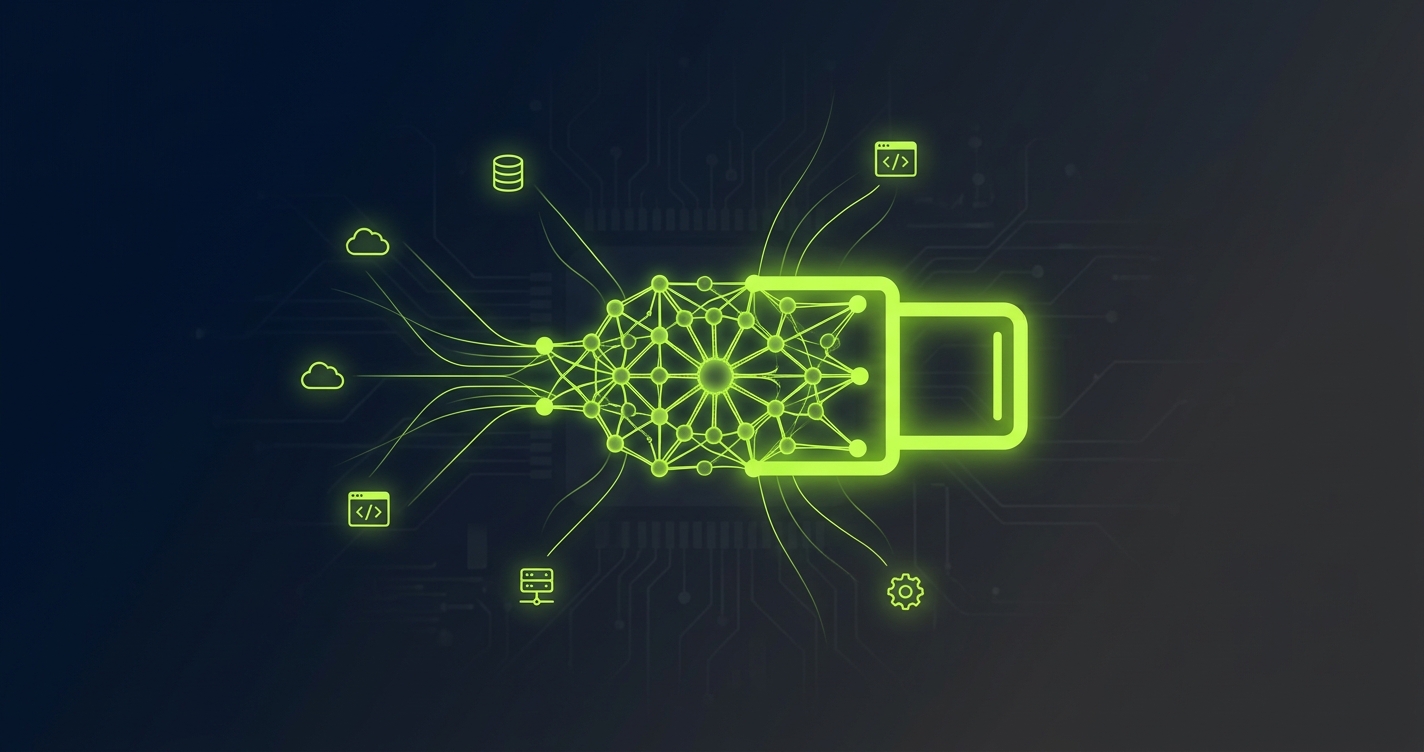
MCP (Model Context Protocol): Como o Padrão USB da IA Está Transformando a Integração de Agentes Empresariais em 2026
O Model Context Protocol (MCP) está rapidamente se tornando o padrão universal para conectar agentes de IA a sistemas empresariais. Com mais de 6.400 servidores, 97M de downloads de SDK e apoio de todas as grandes empresas de IA, aqui está seu guia completo para implementar MCP em 2026.

According to CData's 2026 State of AI Data Connectivity Report, 71% of AI teams spend more than a quarter of their implementation time on data integration alone. That's not building AI features. That's not training models. That's plumbing — connecting AI agents to the CRMs, databases, APIs, and internal tools they need to actually be useful.
That's where MCP comes in. The Model Context Protocol is an open standard doing for AI agent integration what USB did for hardware peripherals — and it's moving fast. In just 16 months, MCP has gone from an Anthropic open-source project to a Linux Foundation-governed industry standard adopted by OpenAI, Google DeepMind, Salesforce, and over 50 enterprise partners.
If you're building or deploying AI agents in your organization, MCP isn't optional anymore. Full stop. Every major AI company has picked their side, and they all picked the same one.
What Is MCP (Model Context Protocol) and Why Should You Care?
The Integration Problem MCP Solves
Before MCP, every AI-to-tool integration was a custom job. Want your AI assistant to query Salesforce? Build a custom connector. Need it to also check Jira tickets? That's another connector. Add Slack notifications, database lookups, and file system access, and you're looking at dozens of bespoke integrations — each with its own authentication logic, error handling, and maintenance burden.
This is the classic N×M integration problem. If you have N AI applications and M tools, you need N×M custom integrations. At enterprise scale, this becomes unsustainable. Teams spend months building connectors instead of delivering value, and every new tool or AI provider means starting from scratch.
The problem isn't theoretical. We see this constantly at Optijara — organizations deploying multi-agent systems in enterprise environments routinely cite integration complexity as the number one barrier to scaling beyond pilot projects.
The USB Analogy: Universal Plug-and-Play for AI
MCP solves this with a universal contract: a standard interface that any AI application can use to discover, connect to, and interact with any tool or data source — without custom integration code on either side.
The analogy that's stuck in the developer community is USB. Before USB, every peripheral needed its own port and driver. USB standardized the connection, and suddenly any device could work with any computer. MCP does the same for AI: once an AI app supports MCP, it can use any MCP server. Once a tool exposes an MCP server, any AI app can use it.
Originally open-sourced by Anthropic in November 2024, MCP is now governed by the Linux Foundation's Agentic AI Foundation — ensuring it remains vendor-neutral and community-driven.
The MCP Ecosystem in 2026: From Experiment to Industry Standard
Adoption Timeline: 16 Months to Linux Foundation
MCP's adoption velocity has been remarkable, even by tech standards:
- November 2024: Anthropic open-sources MCP with Python and TypeScript SDKs
- January 2025: OpenAI adopts MCP, providing critical market validation
- March 2025: Google DeepMind integrates MCP for Gemini; major agent frameworks recommend MCP as the default integration path
- June 2025: Public MCP server registry passes 1,000 servers
- October 2025: Streamable HTTP transport launches, enabling remote cloud services
- December 2025: Linux Foundation assumes stewardship via the Agentic AI Foundation
- March 2026: 6,400+ public servers, SDKs in four languages, 50+ enterprise partners
Here's why this timeline matters: competing AI companies agreeing on a shared standard. When Anthropic, OpenAI, and Google all adopt the same protocol, it's not a bet — it's a settled question.
The Numbers That Matter
The ecosystem metrics tell the story of a protocol that's crossed the tipping point:
- 6,400+ public MCP servers on the official registry (with industry analysts estimating 30,000-50,000 private deployments behind corporate firewalls)
- 97 million SDK downloads across Python, TypeScript, Java, and Go
- 50+ enterprise partners including Salesforce, ServiceNow, and Workday — all shipping official MCP servers
- 76% of software providers are actively exploring or implementing MCP as their AI connectivity standard
Let that sink in. Major enterprise platforms — the systems your organization already runs — are exposing their core APIs through MCP servers. The integration layer is being built. With or without you.
How MCP Works: Architecture and Core Primitives
The Three Primitives: Tools, Resources, and Prompts
MCP organizes AI-to-system interactions around three core primitives:
Tools are actionable operations — the verbs of MCP. Search a product catalog, create a Jira ticket, send a Slack message, run a database query. Each tool is defined by a name, a natural-language description (which the AI reads to understand when to use it), and a JSON Schema defining its inputs. Tools are designed for side-effectful operations where the AI needs to *do* something.
Resources are read-only data sources — the nouns. A product catalog, a configuration file, a list of team members. Resources are identified by URI and MIME type, and they can be listed dynamically so AI agents can discover what data is available at runtime. This is crucial for enterprise environments where available data changes based on user permissions and context.
Prompts are packaged workflows — reusable templates that combine multiple tool calls and resource fetches into coherent operations. A "comprehensive code review" prompt might fetch source files, apply coding standards, pull relevant documentation, and format everything into structured feedback. Prompts encapsulate institutional knowledge about *how* to use the tools effectively.
Protocol Flow: From Discovery to Execution
MCP uses JSON-RPC 2.0 as its message format, following a structured lifecycle:
- Initialize and Handshake: The AI client connects to an MCP server and they exchange capabilities — which primitives are supported (tools, resources, prompts, logging, sampling)
- Capability Discovery: The client requests
tools/listandresources/list, receiving full schemas for everything available - AI Selects and Calls: Based on the user's request and the available tool descriptions, the AI decides which tool to call and constructs a validated
tools/callrequest - Server Executes: The server processes the request and returns a content array (text, images, or resource references)
- AI Iterates: The AI uses the results to continue reasoning, potentially calling more tools or resources
One particularly powerful feature is sampling — an optional capability where MCP servers can request AI completions from the client. This enables "intelligent" servers that can resolve ambiguity, extract structured data, or apply reasoning without running their own AI models.
Transport Options: Local and Remote
MCP supports two transport mechanisms:
- stdio for local integrations — the AI app spawns the MCP server as a child process and communicates via standard input/output. Fast, simple, zero network overhead.
- Streamable HTTP for remote/cloud services — enables MCP servers to run anywhere on the internet, serving multiple AI clients simultaneously.
The Streamable HTTP transport, launched in October 2025, was the unlock for enterprise adoption. It transformed MCP from a local-only developer tool into a cloud-native protocol capable of serving organization-wide AI deployments.
Enterprise MCP Implementation: A Practical 6-Phase Roadmap
Here's a practical roadmap we recommend to clients bringing MCP into their organizations, informed by CData's deployment research and patterns we've seen work:
Phase 1: Pilot with Read-Only Tools
Start with a small, trusted group and low-risk, read-only tools. Expose a few data sources — a product catalog, a knowledge base, a reporting dashboard — as MCP resources. Let your AI agents query but not modify. This phase validates the protocol, surfaces configuration issues, and builds organizational confidence without risk.
Key deliverables: Working MCP server with 3-5 read-only tools, basic telemetry, initial team feedback.
Phase 2: Security Hardening
Before expanding scope, lock down the infrastructure. Implement OAuth2 for authentication, set up secrets management, and deploy an MCP Gateway as the central policy enforcement point. This is where you define who can access what, under which conditions.
Organizations that have invested in AI agent governance and zero-trust frameworks will find this phase significantly smoother — the policy patterns translate directly to MCP.
Key deliverables: OAuth2 integration, MCP Gateway deployed, RBAC policies defined, secrets rotation configured.
Phase 3: Tool Integration and Mapping
Now expand the tool catalog. Register write-capable tools — CRM updates, ticket creation, deployment triggers — and map each tool to its business function with explicit conditions. Not every AI agent should be able to modify production databases; the mapping defines exactly which agent roles can invoke which tools, and under what circumstances.
Key deliverables: Expanded tool catalog with read/write capabilities, tool-to-role mapping documentation, conditional access policies.
Phase 4: Automated Testing
MCP-aware automated testing is where many organizations see dramatic improvements. By validating tool schemas, testing execution flows, and verifying access policies automatically, teams have reported workflow pass rates jumping from 42% to 93% after a single iteration cycle.
Build test suites that validate: tool discovery works correctly, input validation catches malformed requests, permission boundaries are enforced, and error responses are meaningful.
Key deliverables: Automated MCP test suite, CI/CD integration for tool validation, baseline pass rate metrics.
Phase 5: Governance and Compliance
With tools tested and hardened, layer on enterprise governance: SSO integration for unified identity, RBAC tied to your existing directory, comprehensive audit trails capturing every tool invocation, and cost metrics broken down by team and tool.
This phase is where MCP's virtual server architecture shines — you can create isolated MCP environments per team, each with its own tool catalog, permissions, and audit trail. Finance sees ERP tools; operations sees supply chain tools; neither can access the other's systems.
Key deliverables: SSO integration, team-level virtual servers, audit trail dashboard, cost allocation reports.
Phase 6: Scaling Across Teams
With governance in place, scaling becomes a repeatable process: onboard a new team, provision a virtual server, assign tools from the catalog, apply governance policies, and monitor. The hardening work from earlier phases pays dividends here — each new team deployment follows the same pattern.
Key deliverables: Team onboarding playbook, scaling metrics, incident response procedures.
Security and Governance: The Four-Pillar Framework
Enterprise MCP security isn't a single feature — it's a framework built on four pillars:
Zero-Trust and Least Privilege
The most important security principle for MCP: re-authenticate on every tool call, not session tokens. In an agentic context where AI makes autonomous decisions, session-based trust is too broad. Each tool invocation should validate the agent's identity, permissions, and the specific action being requested.
Restrict agent permissions to the absolute minimum required. An AI agent helping with customer support doesn't need access to financial reporting tools. An analytics agent doesn't need write access to the CRM. Define explicit MCP Gateway policies by role, data sensitivity, and operational context.
Multi-Layer Defense and Monitoring
Combine API gateways, inline data redaction, and network firewalls into a defense-in-depth strategy. Centralized logging should capture the complete picture for every tool invocation: agent identity, tool called, parameters passed, response returned, and timestamp.
Monitor for anomalies: unusual invocation volumes, off-hours access patterns, repeated failed authentication attempts, and tool calls outside normal usage patterns. These signals often indicate misconfigured agents or potential security issues before they become incidents.
Compliance: SOC2, HIPAA, GDPR
Regulated industries need centralized audit trails, SAML/SSO integration, and privacy-aware tool exposure. The critical insight: compliance is dramatically easier when designed in from the start. Retrofitting audit trails and access controls onto a running MCP deployment is orders of magnitude harder than building them into Phases 2 and 5 of the implementation roadmap.
For organizations operating in regulated environments, this framework aligns naturally with the governance patterns used in enterprise RAG deployments — the same principles of data access control, audit logging, and compliance verification apply.
Organizational Alignment
The most overlooked pillar: involve legal, security, and compliance teams early. Tool schemas and access policies are architectural decisions that become increasingly difficult to change once agents are in production. A schema that exposes customer PII through a tool's output needs to be caught during design, not after deployment.
The 2026 MCP Roadmap: What's Coming Next
The MCP community published its updated roadmap in early 2026, shifting from date-based milestones to a Working Group-driven priority model. Here's what's on the horizon:
Transport Evolution and Scalability
The current Streamable HTTP transport works but has friction with enterprise load balancers and horizontal scaling. The 2026 roadmap prioritizes evolving the existing transport to support stateless horizontal scaling with explicit session handling, plus a standard metadata format served via .well-known for capability discovery without requiring a full connection.
Importantly, the community has decided: no new transports this cycle. The focus is on making the existing transports production-ready at scale.
Agent Communication Maturation
The Tasks primitive — enabling structured, long-running agent-to-agent communication — shipped experimentally and is working as intended. Production feedback has identified gaps in retry semantics for transient failures and expiry policies for completed task results. These refinements are in active development.
This matters for enterprises building AI-assisted CI/CD and DevOps workflows where multi-step agent tasks need reliable completion guarantees.
Enterprise Readiness Extensions
Common enterprise needs — audit trails, SSO-integrated authentication, gateway behavior, and configuration portability — are intentionally being addressed as extensions rather than core spec changes. This keeps the protocol lean while allowing enterprise-specific functionality to evolve independently.
No dedicated Enterprise Working Group exists yet, which is both a gap and an opportunity. Organizations actively deploying MCP at scale are encouraged to form one and shape the standards that will govern their own deployments.
MCP for MENA Enterprises: Why It Matters for the Region
Standardizing AI Across Heterogeneous IT Environments
Having worked with enterprises across the Gulf, we can tell you: MENA organizations face a specific challenge that MCP is uniquely positioned to solve — they're rapidly adopting AI while managing IT environments that mix legacy on-premises systems, multiple cloud providers, and a growing array of SaaS platforms. The UAE and Saudi Arabia have committed over $150 billion to sovereign AI infrastructure, creating massive demand for standardized ways to connect AI agents to these diverse systems.
MCP provides exactly this standardization. Instead of building custom integrations for each combination of AI provider and enterprise system, MENA organizations can adopt MCP as a unified integration layer — reducing development time, ensuring consistent governance, and avoiding vendor lock-in as the regional AI ecosystem matures.
Data Sovereignty and Compliance Alignment
Data sovereignty is non-negotiable in the Gulf region. MCP's virtual server architecture directly supports data residency requirements: servers can be deployed within national boundaries, tool catalogs can be scoped to comply with local regulations, and audit trails can be maintained per jurisdiction.
For organizations navigating the intersection of rapid AI adoption and strict data governance, MCP provides the architectural foundation to do both without compromise.
Getting Started with MCP: Your Next Steps
If you're evaluating MCP for your organization, here's where to begin:
Assess your integration pain points. Map your current AI-to-tool integrations. How many are custom? How much maintenance do they require? Where are the bottlenecks? This assessment reveals the immediate value MCP can deliver.
Identify 2-3 pilot use cases. Pick use cases where AI agents need tool access but the risk is low — read-only data retrieval, knowledge base queries, or reporting dashboards. These become your Phase 1 pilots.
Evaluate your security posture. Do you have OAuth2 infrastructure? An API gateway? SSO? The answers determine how quickly you can move through the hardening phases.
Consider expert guidance. Enterprise MCP deployment touches infrastructure, security, compliance, and AI architecture simultaneously. In our experience, organizations that move fastest bring in specialized consulting support to navigate the implementation roadmap — particularly for the security hardening and governance phases where architectural decisions have long-lasting consequences.
The protocol is production-ready. The ecosystem is mature. MCP is already the standard for AI agent integration. The only question left is whether your organization moves now or plays catch-up later.
Conclusão
Model Context Protocol has achieved something rare in the technology world: genuine consensus across competing platforms on a shared standard. With 6,400+ servers, 97 million SDK downloads, and backing from every major AI company, MCP is the settled foundation for how AI agents connect to the systems that run your business. For enterprises — particularly in the MENA region where AI investment is accelerating rapidly — the path forward is clear. Start with a pilot, harden your security, build governance into the foundation, and scale systematically. The integration tax that has been holding back enterprise AI adoption finally has a solution.
Perguntas frequentes
O que é o Model Context Protocol (MCP)?
O Model Context Protocol (MCP) é um padrão aberto criado pela Anthropic e agora governado pela Linux Foundation. Ele padroniza como agentes de IA descobrem e interagem com ferramentas, APIs e fontes de dados, funcionando como uma interface universal similar ao que o USB fez para periféricos de hardware.
Como o MCP é diferente das integrações API tradicionais?
Integrações API tradicionais exigem código personalizado para cada conexão IA-ferramenta, criando um problema de complexidade N×M. O MCP substitui isso com um protocolo universal: construa um servidor MCP para sua ferramenta e qualquer aplicação de IA compatível pode usá-lo.
Quais empresas suportam MCP em 2026?
Todos os principais provedores de IA suportam MCP: Anthropic, OpenAI e Google DeepMind. No lado empresarial, Salesforce, ServiceNow, Workday e mais de 50 parceiros lançaram servidores MCP oficiais. 76% dos provedores de software estão implementando MCP ativamente.
O MCP é seguro o suficiente para uso empresarial?
Sim, com arquitetura de segurança adequada: autenticação zero-trust por chamada, defesa em múltiplas camadas com monitoramento centralizado, controles de conformidade SOC2/HIPAA/LGPD e alinhamento organizacional com equipes jurídicas e de segurança.
Quanto tempo leva para implementar MCP em uma empresa?
Uma fase piloto com ferramentas somente leitura pode estar operacional em semanas. A implantação empresarial completa segue um roteiro de 6 fases ao longo de 3 a 6 meses.
O MCP pode funcionar com múltiplos provedores de IA simultaneamente?
Sim. Um único servidor MCP pode servir ChatGPT, Claude, Gemini, Microsoft Copilot e qualquer outro cliente compatível com MCP simultaneamente.
Qual é o roadmap do MCP para 2026?
O roadmap de 2026 foca em quatro áreas prioritárias: evolução do transporte para escalabilidade horizontal, maturação da comunicação entre agentes, melhorias de governança e prontidão empresarial via extensões do protocolo.

Escrito por
Hamza DiazHamza Diaz é o fundador da Optijara, onde cria agentes de IA práticos, sistemas de automação e fluxos de trabalho do Copilot para empresas de serviços. Ele escreve sobre operações de IA, estratégia de agentes e implementação no mundo real para equipes que querem sistemas úteis em vez de exagero.