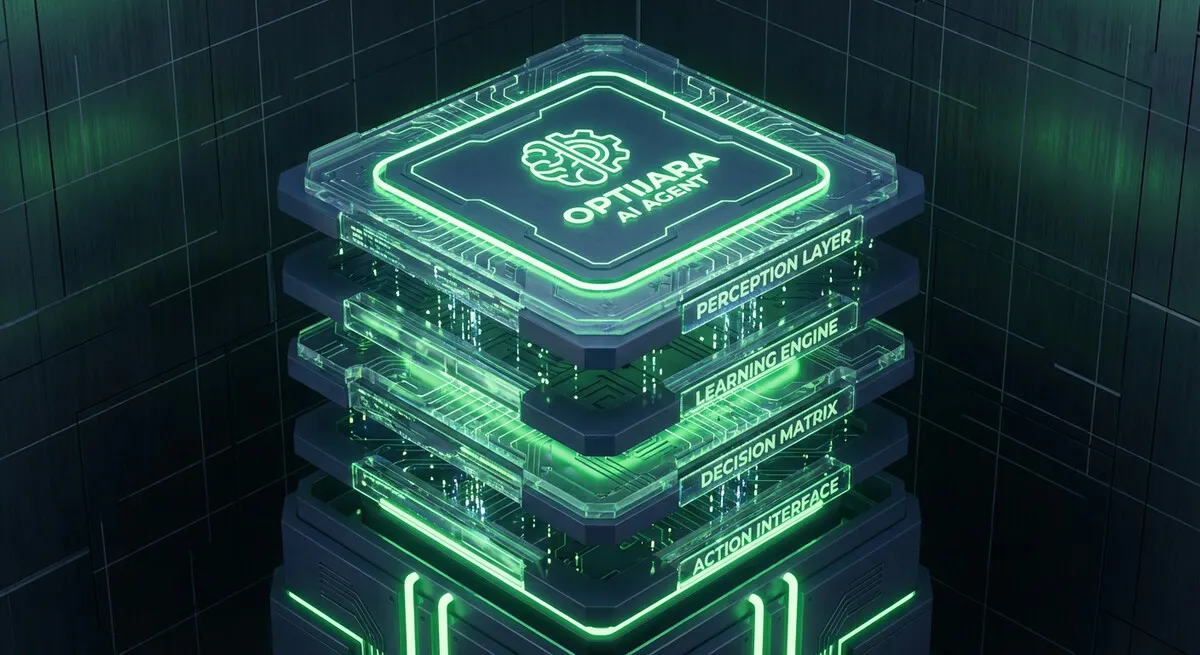
The complete AI agent stack in 2026: LLMs, orchestration, memory, tools, and infrastructure
A comprehensive guide to building production AI agents in 2026, detailing the five essential layers: LLMs, orchestration frameworks, memory systems, tool integrations, and deployment infrastructure.

Building an AI agent in 2026 requires more than an API key and a prompt. The ecosystem has matured into distinct layers — LLM providers, orchestration frameworks, memory systems, tool integrations, and deployment infrastructure — and the choices you make at each layer determine whether your agent handles real work or falls apart after three tool calls.
This guide covers the actual stack that production teams are using right now, based on current adoption patterns, GTC 2026 announcements, and community feedback from developers building agents in production.
The five layers of a production AI agent stack
A production agent stack has five distinct layers, each handling a different responsibility:
- LLM layer — the reasoning engine that processes instructions and generates outputs
- Orchestration layer — the framework that manages how agents think, plan, and chain tasks
- Memory layer — the system that gives agents context beyond the current conversation
- Tools layer — the integrations that let agents take actions in the real world
- Infrastructure layer — the platform that runs, monitors, and scales agent workloads
Each layer has clear leaders and trade-offs. The right combination depends on your use case, team size, and whether you need multi-agent coordination.
LLM layer: choosing your reasoning engine
The LLM layer is the brain of every agent. In March 2026, three providers dominate production agent deployments:
Claude Opus 4 from Anthropic leads for complex reasoning tasks. Its 200K token context window, strong tool-calling accuracy, and consistent instruction-following make it the default choice for agents that need to handle multi-step workflows. Anthropic's focus on safety and reliability appeals to enterprise teams.
GPT-5.3 from OpenAI remains the most widely deployed model overall. Its function-calling API set the standard that other providers now follow. GPT-5.3 offers strong general performance across reasoning, coding, and creative tasks, with competitive pricing at scale.
Gemini 2.5 Pro from Google brings multimodal capabilities and a 1M token context window. For agents that need to process images, video, or extremely long documents, Gemini is often the practical choice. Its integration with Google Cloud services adds value for teams already in that ecosystem.
Open-source options have narrowed the gap significantly. Llama 4 from Meta and Mistral Large 3 handle many agent tasks at a fraction of the cost when self-hosted. For teams with GPU infrastructure, these models offer fine-tuning flexibility and data privacy that closed-source providers cannot match.
| Model | Context window | Best for | Pricing tier |
|---|---|---|---|
| Claude Opus 4 | 200K tokens | Complex reasoning, multi-step workflows | Premium |
| GPT-5.3 | 128K tokens | General-purpose, function calling | Mid-range |
| Gemini 2.5 Pro | 1M tokens | Multimodal, long documents | Mid-range |
| Llama 4 | 128K tokens | Self-hosted, fine-tuning | Infrastructure cost |
| Mistral Large 3 | 128K tokens | European compliance, self-hosted | Infrastructure cost |
Orchestration layer: managing how agents think
The orchestration layer determines how your agent plans, executes steps, handles failures, and coordinates with other agents. This is where most of the engineering complexity lives.
LangChain / LangGraph is the most mature orchestration option. LangGraph provides durable execution, streaming, and human-in-the-loop workflows. With the March 2026 release of Deep Agents, LangChain now includes built-in planning, filesystem-based context management, and subagent delegation. The ecosystem is large: thousands of integrations, extensive documentation, and active community support.
CrewAI focuses specifically on multi-agent coordination. If your use case requires multiple specialized agents working together — one researches, another writes, a third reviews — CrewAI provides role-based agent definitions, task decomposition, and inter-agent communication. It is simpler than LangGraph for multi-agent scenarios but less flexible for single-agent workflows.
OpenClaw takes a different approach entirely. Rather than a Python library, it is an always-on daemon that runs agents through messaging platforms (Telegram, Discord, Slack). Agents have persistent workspaces, cron-based scheduling, and can spawn sub-agents for delegation. OpenClaw became the fastest-growing open source project in history after its viral launch in January 2026, and NVIDIA featured it prominently at GTC 2026 with a "Build-a-Claw" event and a DGX Spark deployment playbook.
AutoGen from Microsoft handles multi-agent conversations with a focus on research and code generation workflows. Its conversation-based architecture lets agents debate, refine, and collaborate. AutoGen works well for scenarios where multiple perspectives improve output quality.
Memory layer: giving agents context
Memory is what separates a useful agent from a stateless chatbot. The memory layer handles both short-term (within a conversation) and long-term (across conversations) information storage.
Vector databases like Pinecone, ChromaDB, and Weaviate power retrieval-augmented generation (RAG). They store embeddings of documents, code, or conversation history and retrieve relevant chunks when the agent needs context. Pinecone leads in managed solutions, while ChromaDB is the go-to open-source option for local development.
LangGraph Memory Store provides structured cross-session memory for agents built on LangChain. Agents can save and retrieve specific information — user preferences, project context, past decisions — without managing a separate database.
File-based memory is the simplest approach and often the most practical. OpenClaw uses SOUL.md, AGENTS.md, and workspace files as persistent memory. Deep Agents uses filesystem tools to write and read intermediate state. For many use cases, structured markdown files provide enough persistence without the complexity of a vector database.
Tools layer: connecting agents to the real world
An agent without tools is a chatbot. The tools layer gives agents the ability to take actions: browse the web, send emails, write code, query databases, manage files, and interact with APIs.
Standard tool categories for production agents:
- Web browsing and search — Tavily, Brave Search API, Playwright for browser automation
- Code execution — sandboxed shells, Docker containers, E2B for cloud sandboxes
- Communication — email via APIs, Slack/Discord/Telegram integrations, calendar management
- Data access — SQL database connectors, API wrappers, file system access
- Workflow automation — n8n, Make (Integromat), Zapier for connecting to SaaS tools
Model Context Protocol (MCP) from Anthropic is emerging as the standard interface between agents and tools. Rather than writing custom integrations for each tool, MCP provides a uniform protocol that any tool server can implement. This means an agent built with MCP can connect to any MCP-compatible tool without custom code. Adoption is growing fast — Cursor, Windsurf, and most major agent frameworks now support MCP.
Infrastructure layer: running agents in production
Running agents in production requires more than a Python script on your laptop. The infrastructure layer handles execution, monitoring, scaling, and reliability.
LangGraph Cloud provides managed infrastructure specifically for LangGraph-based agents. It handles durable execution, streaming, and deployment with built-in monitoring through LangSmith.
Self-hosted options include running agents on cloud VMs (AWS, GCP, Azure), Kubernetes clusters, or edge devices. NVIDIA's DGX Spark, highlighted at GTC 2026, enables running agents locally with GPU acceleration — useful for developers who want to keep data on-premises.
n8n and Make serve as the infrastructure layer for teams that prefer visual workflow builders over code. Both platforms support agent-based workflows with LLM integrations, conditional logic, and webhook triggers.
Putting the stack together: three reference architectures
Solo developer or small startup
- LLM: Claude Opus 4 or GPT-5.3 via API
- Orchestration: OpenClaw (always-on, messaging-first)
- Memory: File-based (SOUL.md, workspace files)
- Tools: MCP servers, browser automation, shell access
- Infrastructure: Single VPS or local machine
Mid-size team with multiple agent types
- LLM: Mixed (Claude for reasoning, Gemini for multimodal, GPT for general tasks)
- Orchestration: LangChain + LangGraph with Deep Agents
- Memory: ChromaDB for RAG + LangGraph Memory Store
- Tools: MCP + custom API wrappers + n8n for workflows
- Infrastructure: LangGraph Cloud or Kubernetes
Enterprise with compliance requirements
- LLM: Self-hosted Llama 4 or Mistral Large 3 + cloud APIs for non-sensitive tasks
- Orchestration: LangGraph with custom guardrails
- Memory: Pinecone or Weaviate with access controls
- Tools: Vetted MCP servers + internal API gateway
- Infrastructure: Private cloud, air-gapped where required
Conclusion
A production AI agent stack in 2026 is defined by its five layers: LLM, orchestration, memory, tools, and infrastructure. While model capabilities like Claude Opus 4 and GPT-5.3 provide the reasoning power, the move toward standardized protocols like MCP and robust orchestration via Deep Agents is what enables developers to transition from simple chatbots to reliable, always-on autonomous systems. Choosing the right stack ultimately depends on your scale, compliance needs, and the complexity of multi-agent coordination required for your use case.
Key Takeaways
- Building effective AI agents in 2026 requires navigating a mature ecosystem beyond just an API key and a prompt.
- The AI agent stack is composed of five distinct layers: LLM, Orchestration, Memory, Tools, and Infrastructure.
- Each layer has a specific responsibility, from reasoning and task management to context retention and real-world actions.
- The choices made at each layer are critical for an agent's ability to perform real work and scale effectively.
- The LLM layer serves as the agent's reasoning engine, with Claude Opus 4 being a dominant provider in production deployments by March 2026.
Conclusion
A production AI agent stack in 2026 is defined by its five layers: LLM, orchestration, memory, tools, and infrastructure. While model capabilities like Claude Opus 4 and GPT-5.3 provide the reasoning power, the move toward standardized protocols like MCP and robust orchestration via Deep Agents is what enables developers to transition from simple chatbots to reliable, always-on autonomous systems. Choosing the right stack ultimately depends on your scale, compliance needs, and the complexity of multi-agent coordination required for your use case.
Frequently Asked Questions
What are the five distinct layers of a production AI agent stack?
A production AI agent stack consists of five layers: the LLM layer (reasoning engine), Orchestration layer (manages agent thinking and task chaining), Memory layer (provides context beyond current conversation), Tools layer (enables real-world actions), and Infrastructure layer (runs, monitors, and scales agent workloads).
Which LLM providers dominate production agent deployments in March 2026?
In March 2026, the leading LLM providers for production agent deployments are Claude Opus 4 from Anthropic (for complex reasoning), GPT-5.3 from OpenAI (general-purpose and function calling), and Gemini 2.5 Pro from Google (multimodal and long documents). Open-source options like Llama 4 and Mistral Large 3 are also strong contenders for teams with specific infrastructure and privacy needs.
What are the key advantages of using open-source LLMs for AI agents?
Open-source LLMs like Llama 4 and Mistral Large 3 offer significant cost savings when self-hosted, fine-tuning flexibility, and enhanced data privacy. They are particularly attractive for teams with existing GPU infrastructure who need to customize models or maintain strict control over their data.
What factors determine the right combination of layers for an AI agent stack?
The optimal combination of layers depends on several factors, including your specific use case, the size and capabilities of your team, and whether your agent requires multi-agent coordination. Each layer has clear leaders and trade-offs that need to be considered.
Why is building an AI agent in 2026 more complex than just using an API key and a prompt?
The AI agent ecosystem has matured into distinct, specialized layers, each requiring careful selection and integration. An agent's ability to handle real-world tasks and avoid failures after a few tool calls depends on making informed choices across LLM providers, orchestration frameworks, memory systems, tool integrations, and deployment infrastructure.
Sources

Written by
OptijaraHamza Diaz is the founder of Optijara, where he builds practical AI agents, automation systems, and Copilot workflows for service businesses. He writes about AI operations, agent strategy, and real-world implementation for teams that want usable systems instead of hype.