AI and Sensory Science: How Machine Learning Decodes Taste, Smell, and Scent Without Replacing Human Panels
Discover how Osmo, MIT's SmellNet, Givaudan, and DSM-Firmenich use AI to map smell and flavor, augmenting rather than replacing human sensory panels.

Introduction: The Frontier of Digital Sensation
In 2024, a team of researchers successfully captured the volatile organic compounds of a ripe plum, converted the chemical signatures into a digital signal, and recreated that identical fragrance on the other side of a room. Scent teleportation is real. It is also just the beginning. While computer science spent the last decade conquering vision and speech, it is finally tackling the hardest problem of all. Sensory science. Many R&D teams struggle with this transition daily. Turning physical sensation into structured digital data changes everything about product development.
Bridging the Sensation Gap: Vision, Audition, and the Chemosensory Domain
We have spent decades mapping sight and sound. Computer vision turns light into pixels. Audio models turn pressure into digital waves. The math is straightforward. Scent and flavor do not work this way. They depend on thousands of volatile organic compounds hitting hundreds of distinct receptors in your nose and mouth. A single coffee aroma contains over eight hundred molecules. It is a high-dimensional mess. This complexity forces the flavor and fragrance industries to rely on slow, manual blending.
Moving Past the GC-MS Bottleneck
Analytical chemistry leans heavily on Gas Chromatography-Mass Spectrometry (GC-MS). GC-MS is great at giving you a chemical receipt. It tells you exactly what molecules are in a mixture. It cannot tell you what it actually smells like. A GC-MS readout cannot confirm if a formula smells like fresh citrus or old wood. By combining deep learning with structural chemistry, researchers are finally mapping chemical structures directly to human sensory descriptions. R&D teams can now bypass slow lab work. They screen millions of combinations in a fraction of a second. The speed is staggering.
The Core Thesis: AI Speeds Up, Humans Taste
A common misunderstanding persists. Executives assume algorithms will completely replace their human sensory panels. This is false. AI is an accelerator. It is not a substitute. Algorithms generate a "formula skeleton" and filter out the obvious failures based on physics, cost, or regulations. Human panels handle the rest. They capture the subjective, physical qualities of flavor and physical texture that machines simply cannot measure. The future is hybrid. Integrating chemical intelligence into digital systems offers global consumer goods companies a significant advantage.
Machine Olfaction: Decoding Scent at the Molecular Level
Osmo's Olfactory Intelligence
The biggest leap in digital scent technology happened in 2022 with Osmo. Led by olfactory neuroscientist Alex Wiltschko out of Google Brain, Osmo started mapping chemical structures directly to scent descriptors. They published a milestone paper in Science in 2023. Their Graph Neural Network (GNN) predicted how a novel molecule smells based strictly on its structure, often beating individual human raters. By 2026, Osmo had raised a seventy million dollar Series B and opened a massive New Jersey R&D facility. With pioneers like Geoffrey Hinton advising them, Osmo proved that machine learning turns the art of trial and error into predictive science.
MIT Media Lab's SmellNet
Clean laboratory predictions are helpful. Real-world environments are noisy, messy, and chaotic. The MIT Media Lab Multisensory Intelligence group built SmellNet to address this exact problem. SmellNet is the first large-scale, real-world smell dataset. It contains over one hundred and eighty thousand time steps across fifty plant-based and food substances. It captures the dynamic, temporal nature of smell as compounds actually disperse through the air over fifty hours of data.
Preprocessing Scent Signals
SmellNet uses First-Order Temporal Differences to process these complex signals. This mathematical method calculates the rate of change in sensor resistance over time. It filters out slow environmental drift. It highlights rapid chemical changes. Paired with high-resolution GC-MS data, SmellNet allows deep learning models to perform cross-modal learning. The applications are immediate. Hand-held electronic noses can now spot microscopic traces of gluten or peanuts in commercial food facilities before an allergic reaction occurs.
Augmented Creativity: AI in Flavor and Fragrance Formulation
DSM-Firmenich's First AI Flavor
This technology is already live. In 2024, DSM-Firmenich created the world's first algorithmically generated flavor. It was a natural, lightly grilled beef taste designed for plant-based meat alternatives. Creating realistic meat alternatives is incredibly difficult. Plant proteins introduce bitter, earthy notes. You have to mask the off-notes while recreating the complex, savory profile of cooked beef.
Givaudan's CARTO System
DSM-Firmenich used a rule-based formula generation model that analyzed decades of raw material usage statistics. The model followed strict constraints. The flavor had to be 100% natural, hit a precise cost target, and pass global food safety laws. Competitor Givaudan took a different approach with CARTO at its Paris Digital Factory. CARTO uses an interactive touchscreen connected to a specialized formulation robot. Perfumers design formulations visually. The robot physically mixes and bottles a real ingredient sample in seconds.
The Formula Skeleton
This robotic-algorithmic pairing introduces the "formula skeleton," significantly accelerating R&D cycles. The AI generates an optimized structural framework that meets all regulatory and cost constraints. The perfumer takes this skeleton and applies creative expertise to refine the sensory notes.
The Dual-Loop Sensory Alignment (DLSA) Framework
The Inner Loop: Machine Predictions
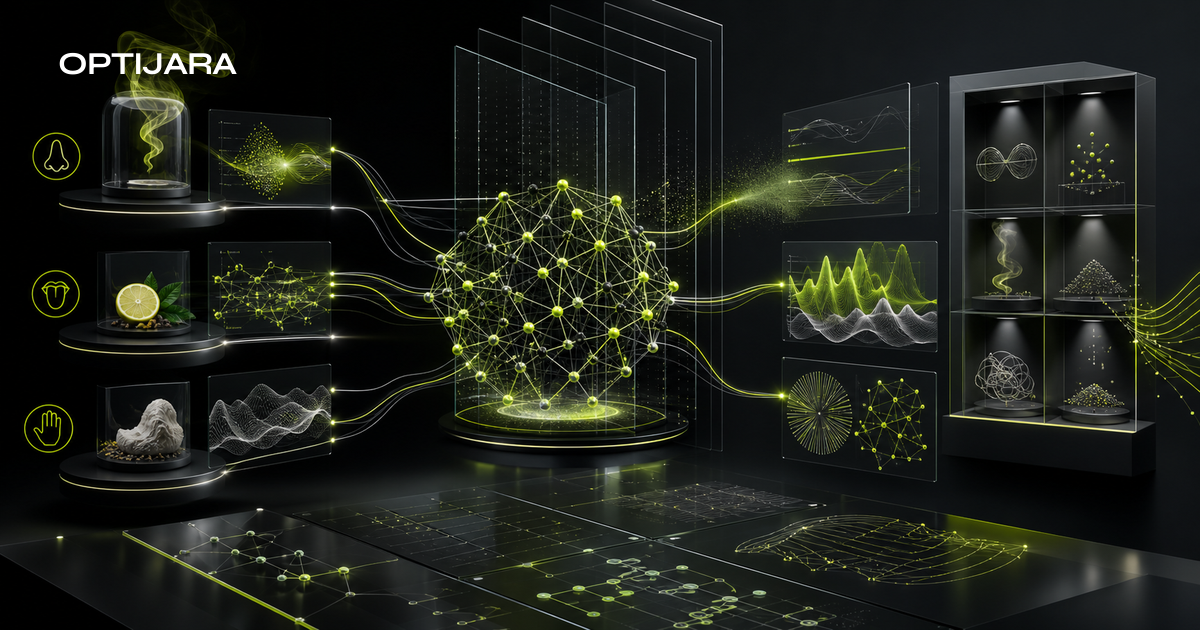
At Optijara, we developed the Dual-Loop Sensory Alignment (DLSA) Framework to guide organizations through this transition. The process starts with the Inner Loop. This is the Chemistry-to-Vector Mapping. Raw chemical inputs go into deep learning models. These models project the profiles into high-dimensional sensory vectors, predicting how the mixture will register on human receptors. R&D teams use this loop to run high-throughput screening in silico. They explore millions of chemical combinations instantly.
| DLSA layer | What AI does | What humans still decide | Failure mode if skipped |
|---|---|---|---|
| Data foundation | Cleans formula, GC-MS, sensor, and panel history | Defines the sensory vocabulary that matters | The model optimizes labels nobody trusts |
| Inner loop | Screens molecules, constraints, and formula skeletons | Sets acceptable cost, regulatory, and ingredient boundaries | Fast outputs that cannot ship |
| Outer loop | Prioritizes candidates for testing | Judges texture, memory, culture, and preference | Technically correct products that feel wrong |
| Feedback loop | Updates embeddings and prediction weights | Explains why a panel rejected a candidate | Repeating the same formulation mistakes |
The Outer Loop: Human Panels
Once the Inner Loop isolates the best formula skeletons, the Outer Loop takes over. The candidate samples are physically mixed using systems like Givaudan's CARTO. They go directly to trained human sensory panels. An AI can predict molecular properties. It cannot experience the complex mouthfeel of a fat alternative, the physical cooling of a mint compound, or the nostalgia triggered by a specific scent. Human panels evaluate texture, aftertaste, temporal release, and psychological appeal.
Synthesizing the Feedback Loop
The framework works because these loops constantly synchronize. The human panel's qualitative evaluations are digitized and fed back into the AI model as training data. The model compares its predicted vector with the actual human ratings. It adjusts its internal weights. It gets smarter.
Why AI Cannot Replace Human Panels
The Chiral Conundrum
Physical chemistry creates hard limits for machine sensation. Structural isomers and chiral molecules are the perfect example. Chiral molecules have the exact same chemical formula. They are non-superimposable mirror images of each other, like a left and right hand. Because human olfactory receptors are also chiral, they interact differently with these mirror images. L-carvone smells like fresh spearmint. D-carvone smells like earthy caraway seeds. To a standard AI model analyzing a 2D chemical representation, they look identical. They produce completely different sensory experiences. You need human validation to confirm the outcome.
Sensor Drift and Environmental Noise
In real-world factory environments, environmental noise often compromises static models. Biological noses naturally adapt to different environments. Electronic noses do not. They are highly sensitive to variations in humidity, temperature, and atmospheric pressure. Chemical sensors degrade over time from microscopic contamination. A sensor reading in a clean lab will differ wildly from a reading in a humid factory. Static predictive databases are useless without constant human-in-the-loop recalibration.
The Subjective Nature of Flavor
Flavor and scent are deeply subjective. A sensory response is shaped by cultural background, memories, and physical context. A scent that brings comfort to one demographic may disgust another. An AI model can predict that a molecule smells like cardamom. It cannot predict if a consumer panel in a specific region will actually want to drink it in a morning beverage. Human panels do not just detect chemical signals. They evaluate emotional resonance.
Pitfalls and Pitches: What Teams Get Wrong
Mistake 1: Treating AI as a Drop-in Replacement
R&D departments sometimes attempt to use AI to completely replace human sensory panels to cut clinical testing costs. This approach often leads to products with suboptimal flavor profiles and textures. AI speeds up the early screening. Humans polish the final experience.
Mistake 2: Ignoring Environmental Noise
Teams regularly deploy sensitive gas sensors on active factory floors without proper shielding. The sensors pick up adhesives or cardboard. The AI makes incorrect predictions based on distorted readings. Clean data collection is mandatory.
Mistake 3: Over-reliance on Static Databases
Many teams build a custom predictive model using historical data and never update it. Consumer preferences and raw material supplies change. Specific synthetic musks get restricted. Without feeding fresh human evaluations back into the model to update its weights, the predictions diverge from market reality.
The R&D Decision Matrix
Choosing the Right Technology
We compiled a decision matrix to help R&D directors choose between traditional laboratory analysis, digital olfaction, and human sensory panels. Traditional GC-MS gives you a molecular count. It is slow and completely objective. Digital olfaction gives you rapid perceptual predictions. Human panels give you complex subjective experience.
| Method | Best use | Strength | Limitation |
|---|---|---|---|
| GC-MS and lab chemistry | Identifying compounds and concentrations | Precise molecular evidence | Does not explain human preference by itself |
| Machine olfaction | Predicting scent or allergen patterns from signals | Fast screening across large candidate spaces | Sensitive to sensor drift and environmental noise |
| AI formulation tools | Generating formula skeletons under constraints | Speeds early R&D exploration | Needs real-world validation before launch |
| Human sensory panels | Scoring taste, smell, texture, and context | Captures lived preference and cultural meaning | Slower and more expensive to scale |
| Implementation step | Practical action | Evidence to collect |
|---|---|---|
| 1. Audit the data | Combine formula records, panel notes, GC-MS outputs, and sensor logs | Completeness, duplicate rates, missing descriptors |
| 2. Define constraints | Set cost, natural ingredient, allergen, regulatory, and brand boundaries | Constraint pass/fail rate |
| 3. Run inner-loop screening | Generate candidate formula skeletons with AI | Candidate quality and rejection reasons |
| 4. Validate with panels | Test a small set of candidates with trained humans | Panel agreement and preference spread |
| 5. Calibrate the model | Feed panel results back into the model | Improved prediction alignment over time |
{
  "framework": "Dual-Loop Sensory Alignment",
  "ai_role": "screen chemical and formulation possibilities",
  "human_role": "validate preference, texture, context, and emotional fit",
  "primary_risks": ["sensor drift", "weak sensory labels", "over-reliance on formula skeletons", "missing cultural context"],
  "success_metrics": ["panel agreement", "candidate rejection reasons", "constraint pass rate", "model calibration improvement"]
}
When to Deploy AI vs. Physical Experts
Deploy AI during the early and middle stages of the R&D pipeline. Use models like Osmo or CARTO to filter out thousands of bad chemical combinations, optimize costs, and pass regulatory checks. Bring in human panels for the shortlist. Humans evaluate physical mechanics like the melt of a vegan cheese or the crunch of a snack.
A Practical Implementation Checklist
Follow this checklist to integrate AI into your sensory workflows. First, consolidate past formulation records into a machine-readable database. Second, establish clear boundaries for your AI models, including cost and regulatory requirements. Third, integrate predictive algorithms to generate optimized formula skeletons. Fourth, design formal feedback channels where human panel scores are digitized and fed back into your models. Finally, install automated environmental logging to correct for temperature and humidity.
Scaling Creativity in Food and Fragrance
The Bioelectronic Future
The future of sensory science lies in fusing biology and electronics. Researchers are working to stabilize mammalian olfactory receptors on bioelectronic microchips. A 2025 review paper by Andreas Mershin and Paul Pu Liang detailed these systems. They aim to achieve single-molecule detection resolution matching canine olfactory systems. Future digital noses will detect diseases, spot environmental toxins, and evaluate complex fragrances with biological precision.
Scent Teleportation is Here
Osmo proved this molecular precision with a 2024 scent teleportation experiment. They analyzed a ripe plum, translated the chemical signals into a digital coordinate map, transmitted the coordinates, and physically synthesized an identical scent profile across the room using an automated fragrance printer.
The Real Value of Augmented Creativity
The integration of AI into sensory science is not about replacing the human palate. It is about augmented creativity. These tools free creative minds from repetitive, manual calculations. R&D teams experiment with novel, upcycled ingredients at unprecedented speed. The AI handles the regulations and costs. By combining the predictive power of the machine with the subjective brilliance of human panels, brands can build a future where food is more sustainable and fragrances are perfectly tuned to human preference.
Key Takeaways
- 1Digital olfaction and gustation are highly complex chemosensory domains that require mapping raw chemical structures directly to biological receptor behaviors rather than simple waves.
- 2Osmo's Graph Neural Networks can predict molecular odor profiles directly from chemical structure, supported by a 58,000 square foot New Jersey R&D facility and over three billion mapped molecules.
- 3The MIT Media Lab's SmellNet dataset provides over 180,000 time steps of real-world scent data, utilizing First-Order Temporal Differences for rapid real-world allergen detection.
- 4Flavor and fragrance giants like DSM-Firmenich and Givaudan are utilizing rule-based models and CARTO robotics to generate 'formula skeletons' and speed up formulation from months to minutes.
- 5The Dual-Loop Sensory Alignment (DLSA) Framework balances an AI-powered Inner Loop for high-throughput screening with a human-powered Outer Loop for subjective and sensory validation.
- 6The 'digital smell gap' caused by chiral molecules and structural isomers demonstrates that AI cannot fully replace human panels, as mirror-image molecules can look identical chemically but smell completely different.
- 7Successful enterprise implementation requires continuous panel calibration to avoid static database obsolescence and careful environmental calibration to protect sensors from drift and noise.
Conclusion
The digitization of sensory science marks a historical shift from trial-and-error chemistry to predictive formulation. Separating the formula calculations from the artistic refining process allows companies to iterate instantly while relying on human sensory panels to validate emotional and cultural resonance. As bioelectronic receptors and digital scent printers mature, the brands that implement structured workflows today will define the sensory products of tomorrow. To assess your digital readiness and start building your custom predictive databases, contact the Optijara AI advisory team.
Frequently Asked Questions
Can artificial intelligence completely replace human sensory panels?
No. While AI excels at rapid molecular screening and generating starting configurations (known as 'formula skeletons'), human sensory panels remain indispensable. Human evaluators are essential for capturing complex subjective factors such as mouthfeel, aftertaste, emotional resonance, and culturally specific preferences.
What is machine olfaction and how does it work?
Machine olfaction is the digital capture and prediction of smell. It combines physical chemical sensors (or stabilized biological receptors) with machine learning algorithms, such as Graph Neural Networks, to analyze a molecule's chemical structure and predict how a human will perceive its scent profile.
How did DSM-Firmenich create the world's first AI flavor?
DSM-Firmenich generated a natural, lightly grilled beef flavor for plant-based meat alternatives by using a rule-based formula generation model. The model analyzed their extensive historical formulation databases while strictly adhering to constraints like using 100% natural ingredients, meeting cost targets, and satisfying regulatory guidelines.
What is Givaudan's CARTO tool?
CARTO is an interactive AI-assisted tool developed under Givaudan's Paris Digital Factory. It allows perfumers to design fragrance formulations on a large touchscreen interface. This interface is connected to a physical formulation robot that mixes and delivers a real ingredient sample in seconds, drastically shortening the R&D iteration cycle.
What is MIT's SmellNet dataset?
SmellNet is the first large-scale, open-source real-world smell dataset, created by the MIT Media Lab Multisensory Intelligence group. It contains over 180,000 time-series data points (representing roughly 50 hours of sensor logs) across 50 food and plant-based substances, enabling models to perform real-world allergen and compound detection.
Sources
- https://arxiv.org/html/2510.19660v2
- https://www.media.mit.edu/projects/ai-for-smell-and-taste/overview/
- https://www.osmo.ai/about
- https://www.dsm-firmenich.com/en/businesses/taste-texture-health/news-events/articles/tonalities/worlds-first-ai-created-flavor.html
- https://www.givaudan.com/fragrance-beauty/perfumery-school/carto-the-future-of-fragrance-formulations

Written by
Hamza DiazHamza Diaz is the founder of Optijara, where he builds practical AI agents, automation systems, and Copilot workflows for service businesses. He writes about AI operations, agent strategy, and real-world implementation for teams that want usable systems instead of hype.