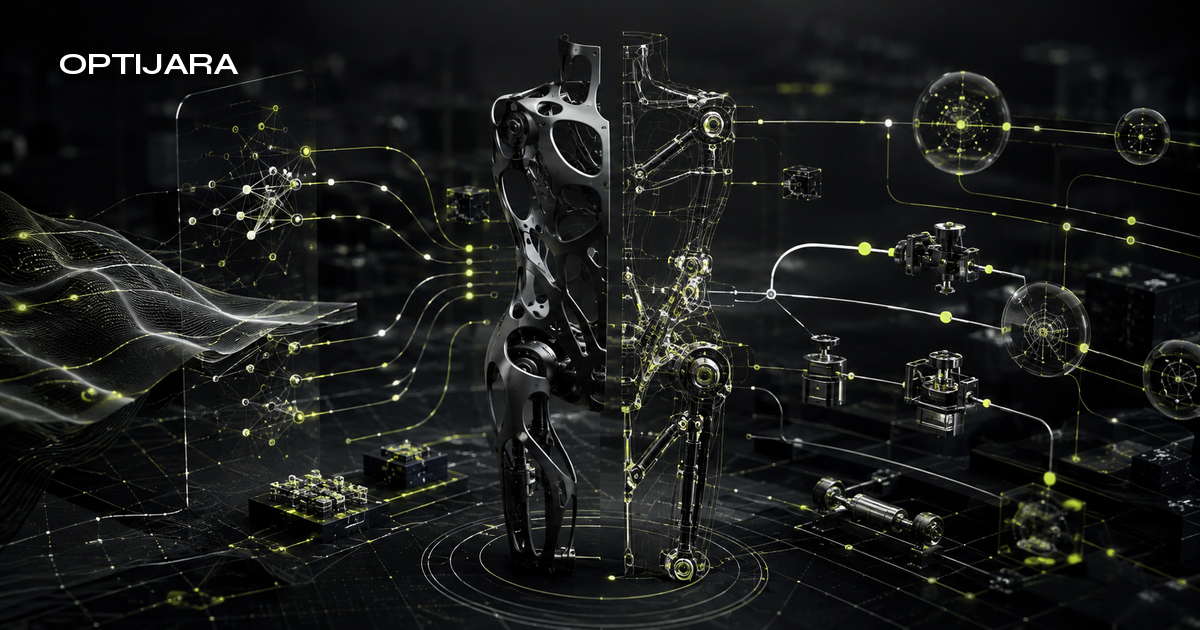
BRIDGE Humanoid Platform: A Morphology-Control Co-Design Playbook for Physical AI Prototyping
BRIDGE presents an open-source humanoid platform built around morphology-control co-design, but physical AI teams should treat the paper as a route to verify rather than a claim to accept. This playbook introduces Optijara's Embodiment Route Acceptance Test for checking morphology fidelity, retargeting, whole-body control, hardware-control coupling, reproducibility, licensing, safety, and benchmark reproduction before committing lab time.

In software AI, a weak prototype usually gets reverted in a pull request. In humanoid robotics, a weak prototype has mass, motors, heat, cables, batteries, and fall risk. That difference changes the adoption question. BRIDGE matters because morphology-control co-design makes the robot body part of the model interface. Limb proportions, joint limits, feet, hands, mass distribution, actuators, sensors, and controller assumptions all affect what the system can learn, imitate, stabilize, and repeat safely.
The BRIDGE paper presents an 88 cm open-source humanoid platform with control policy materials and a morphology-control co-design approach for physical AI. The authors report state-of-the-art results across selected metrics against baseline humanoids. Treat those results as author-reported until another team reproduces the relevant build, simulator setup, controller stack, and benchmarks. That is not cynicism. It is how physical AI should be assessed before a lab spends money or exposes people to moving hardware.
The decision is not "Is the paper exciting?" The useful decision is "Can we trace the route from claim to artifact to lab evidence without guessing?" Optijara's framework for that decision is the Embodiment Route Acceptance Test, or ERAT. It gives teams a five-gate route for deciding whether to adopt, adapt, observe, or reject BRIDGE before ordering parts, retargeting motion data, or putting powered hardware on a lab floor.
Why BRIDGE Makes Morphology-Control Co-Design Harder to Ignore
BRIDGE is timely because it puts hardware design and whole-body control in the same evaluation loop. Software teams can hide loose assumptions behind APIs, checkpoints, and dashboards for a while. Robotics teams eventually meet the floor. A simulator result still has to survive gravity, friction, actuator limits, contact instability, sensor noise, latency, manufacturing tolerance, and human safety boundaries. Once a robot is embodied, the body is not a neutral container for intelligence. It is a constraint, a sensor platform, and a source of failure.
The paper's useful shift is conceptual. Morphology is no longer just mechanical engineering documentation. It is part of the learning and control interface. MuJoCo provides a physics simulation environment where model files, contacts, joints, actuators, constraints, and sensors become executable assumptions. MuJoCo Menagerie collects robot models for simulation use. ToddlerBot shows another open humanoid effort where physical form, low-cost build choices, and control experiments are connected. Commercial humanoids such as Unitree G1 provide useful morphology references for comparison, although comparison does not imply equivalence.
For adjacent Optijara evaluation patterns, compare our Isaac 0.5 video-to-action transfer acceptance test, Legato VLA chunk-boundary continuity test, NVIDIA Warp route acceptance test, and WeatherNext 3 forecast freshness decision test. The shared principle is simple: define the evidence before rewarding the demo.
The Optijara Embodiment Route Acceptance Test
A route is the traceable path from paper claim to public artifact, build instruction, simulation model, controller configuration, benchmark script, and reproduction result. BRIDGE should be evaluated through five gates: morphology route fidelity, motion retargeting route, whole-body control route, hardware-control coupling route, and reproducibility, artifact, and license route.
| ERAT gate | What the route must prove | Evidence to collect | Blocking question |
|---|---|---|---|
| Morphology route fidelity | Simulated and physical bodies line up closely enough for meaningful evaluation | Dimensions, joint limits, inertial parameters, CAD, URDF or MJCF, actuator specs, contact surfaces | Are key body parameters missing, inconsistent, or unmeasured? |
| Motion retargeting route | Human or reference motions map without hiding infeasible movement | Motion provenance, mapping assumptions, joint-limit handling, contact checks, failure examples | Does the route show what happens when motion cannot fit the robot? |
| Whole-body control route | Controller stability boundaries are specified well enough to reproduce | Architecture, gains, configs, estimator assumptions, recovery behavior | Can another team run the same controller conditions? |
| Hardware-control coupling route | Real hardware limits are reflected in control tests | Current, temperature, latency, battery, payload, manufacturing variation logs | Are thermal, electrical, and latency limits visible? |
| Reproducibility and license route | Artifacts can be used legally and technically for the intended purpose | Commit hashes, dependencies, build files, datasets, licenses, permissions | Are any required artifacts missing or legally unclear? |
{
  "framework": "Optijara Embodiment Route Acceptance Test",
  "platform": "BRIDGE humanoid platform",
  "decision": ["adopt", "adapt", "observe", "reject"],
  "minimumEvidence": ["morphology diff", "retargeting log", "controller config", "hardware safety log", "license register", "benchmark reproduction note"]
}
What to Verify in the BRIDGE Paper and Public Artifacts
Start with canonical sources: the arXiv abstract, arXiv HTML, DOI, project page, and any linked repositories. Build a claim register that separates design claims, release claims, metric claims, and performance claims. A design claim may describe morphology-control co-design. A release claim may describe open-source materials. A metric claim may define retargeting fidelity and dynamic tracking. A performance claim may compare BRIDGE with baseline humanoids. Each one needs a different kind of evidence.
Simulation assets are not documentation unless they can be tested. A reproducible simulation route includes dependency versions, launch commands, environment settings, controller configs, seed handling, benchmark scripts, expected outputs, and known failure cases. The minimum bar is a morphology diff. Load the model, extract dimensions, joint limits, actuator definitions, masses, contact geoms, and sensor frames, then compare them against paper and build files.
| Artifact class | Verify | Why it matters |
|---|---|---|
| Robot description | URDF or MJCF, meshes, frames, scale, joint axes | Prevents learning or testing against the wrong robot |
| Mechanical evidence | CAD, BOM, actuator specs, foot geometry, mass distribution | Connects simulator assumptions to physical build limits |
| Control evidence | Controller configs, gains, estimator assumptions, policy files | Determines whether whole-body control can be rerun |
| Benchmark evidence | Scripts, seeds, comparison baselines, model hashes, expected logs | Separates benchmark citation from benchmark reproduction |
| License evidence | Code, CAD, meshes, datasets, trained policies, documentation | Avoids discovering usage constraints after integration |
A humanoid platform without a clean artifact trail can still be useful for research, but it carries more uncertainty than a platform with reproducible models, scripts, logs, and license records. A lab can still learn from it, but the decision should be treated as research exploration rather than platform adoption.
Practical Lab Test Plan
Day 0 is an artifact audit before ordering parts. Collect paper URLs, project page, repositories, commit hashes, license files, build instructions, BOM, CAD, simulator models, controller configs, datasets, videos, and issue threads. Rank each gap by consequence. Some gaps only require a note. Others block simulation, hardware build, commercial use, or safety review.
Week 1 is simulation bring-up and morphology diff. If BRIDGE provides MuJoCo assets, load them in a pinned environment and run model inspection. Extract dimensions, joint ranges, masses, actuator definitions, contact geometries, and sensor frames. Static checks come first. The model should load, joint limits should make physical sense, collisions should be plausible, feet should contact the ground as expected, sensors should report plausible values, and the robot should hold a neutral pose in simulation.
Week 2 is retargeting and whole-body control dry runs. Test stand, safe crouch, step in place, slow walk, turn, reach, and recovery from a small simulated perturbation. Record retargeting error if available, joint saturation, foot contact consistency, torso posture, control effort, and failure modes. Vary friction, payload assumptions, initial posture, and controller settings where possible.
A simple hypothetical failure is useful here. Suppose a reference motion asks for a hip angle the robot cannot reach while the foot remains planted. A weak route clips the joint silently and shows a polished video. A testable route logs the saturation, marks the contact inconsistency, and shows the failed motion next to the accepted one. That is the difference between a demo and an engineering asset.
Week 3 is hardware-in-the-loop and safety-limited motion only if artifact, simulation, and safety prechecks pass. Confirm joint directions, encoder calibration, soft limits, torque limits, emergency stop behavior, battery monitoring, temperature logging, command latency, and data logging. Use low-speed, tethered, supervised tests before dynamic motion.
| Criterion | Adopt | Adapt | Observe | Reject |
|---|---|---|---|---|
| Artifact completeness | Core files and scripts are available and versioned | Minor gaps have workarounds | Important gaps may be fixed later | Critical artifacts are missing |
| Morphology fit | Body matches task envelope and lab constraints | Design is close but needs changes | Fit is uncertain | Geometry or actuation is unsuitable |
| Reproducibility | Key demos or benchmarks rerun with documented deltas | Partial reproduction is acceptable | Reproduction path is unclear | Claims cannot be tested |
| Control stability | Stable across expected low-risk variations | Needs tuning your team can perform | Too early to judge | Brittle or unsafe in basic tests |
| Safety readiness | Lab process covers staged testing | Additional controls are needed | Safety depends on missing info | Safe testing is not feasible |
| Licensing clarity | Intended use is compatible | Some permissions need review | License questions are open | Intended use conflicts with licenses |
Common Mistakes and Caveats
Teams often treat the body as interchangeable plumbing around a controller. In humanoids, limb lengths affect reachable poses, foot geometry affects contact and balance, actuator torque affects feasible acceleration, compliance changes impact response, and sensor placement affects observability. A controller trained or tuned for one body may not transfer cleanly to another.
A second mistake is trusting demo videos more than reproducible routes. Videos are useful because they show what the authors chose to demonstrate. They are not enough to prove repeatability, general capability, or safety. Map demos to scripts, configs, model files, controller versions, motion sources, and test conditions.
A third mistake is skipping controller-hardware coupling tests. Motors heat, batteries sag, timing jitters, sensors drift, cable routing interferes, printed parts flex, and manufacturing variation changes alignment. Test current, temperature, voltage, latency, calibration, and recovery behavior before dynamic movement.
License review is also engineering work. Source code, hardware files, CAD, firmware, datasets, trained policies, meshes, documentation, and dependencies can carry different permissions. Check them before integration, not after a prototype already depends on them.
BRIDGE is most useful when evaluated as a morphology-control co-design route, not merely as an open-source humanoid headline. The Optijara Embodiment Route Acceptance Test asks teams to verify morphology fidelity, motion retargeting, whole-body control, hardware-control coupling, reproducibility, artifacts, licenses, safety boundaries, and benchmark reproduction before committing lab resources. Paper performance claims may prove meaningful, but they should remain author-reported until independent teams reproduce the relevant build, simulation setup, controller stack, and benchmarks. A practical advisory team can turn this kind of robotics research into acceptance tests, artifact audits, prototype roadmaps, and decision matrices without pretending the paper is already a deployable platform.
Key Takeaways
- 1BRIDGE should be evaluated as a morphology-control co-design route, not only as an open-source humanoid announcement.
- 2Paper performance claims should remain author-reported until independent teams reproduce the build, simulation, controller stack, and benchmarks.
- 3Morphology fidelity needs measured dimensions, joint limits, inertial parameters, actuator specs, and simulator-to-hardware diffs.
- 4Motion retargeting and whole-body control should be tested with failure cases, sensitivity checks, and clear controller configuration evidence.
- 5Hardware-control coupling requires current, temperature, latency, battery, payload, and manufacturing-variation logs before dynamic motion.
- 6License and artifact verification should happen before ordering parts or integrating BRIDGE into a lab roadmap.
Conclusion
BRIDGE deserves attention because it connects body design with whole-body control. Adoption should wait for traceable artifacts, simulator checks, controller evidence, hardware logs, license review, and staged safety tests.
Frequently Asked Questions
What is the BRIDGE humanoid platform?
BRIDGE is presented by its authors as an open-source 88 cm humanoid platform connected to a morphology-control co-design framework for physical AI. Teams should independently verify artifacts, licenses, simulation assets, controller details, and benchmark reproduction before adoption.
What does morphology-control co-design mean in humanoid robotics?
It means robot body parameters and control strategy are designed and evaluated together. Limb geometry, joint limits, actuation, sensors, mass distribution, foot contact, and compliance affect feasible motion and stability.
How should a lab evaluate BRIDGE before building on it?
Run the Optijara Embodiment Route Acceptance Test: verify morphology fidelity, motion retargeting, whole-body control, hardware-control coupling, reproducibility, licenses, safety boundaries, and benchmark reproduction.
Are BRIDGE performance results independently proven?
This article treats BRIDGE performance claims as author-reported unless independent labs reproduce the build, controller stack, simulation setup, motion retargeting route, and benchmarks under documented conditions.
Why is motion retargeting difficult for humanoid robots?
Humanoids differ in limb proportions, joint ranges, contact timing, balance constraints, actuator limits, compliance, and coordination, so a human-like motion may saturate joints, skate feet, or destabilize another robot.
Sources
- https://arxiv.org/abs/2609.03497
- https://arxiv.org/html/2609.03497
- https://doi.org/10.48550/arXiv.2609.03497
- https://sites.google.com/view/bridgerobot
- https://toddlerbot.github.io/
- https://mujoco.readthedocs.io/en/stable/overview.html
- https://github.com/google-deepmind/mujoco_menagerie
- https://www.unitree.com/g1

Written by
Hamza DiazHamza Diaz is the founder of Optijara, where he builds practical AI agents, automation systems, and Copilot workflows for service businesses. He writes about AI operations, agent strategy, and real-world implementation for teams that want usable systems instead of hype.