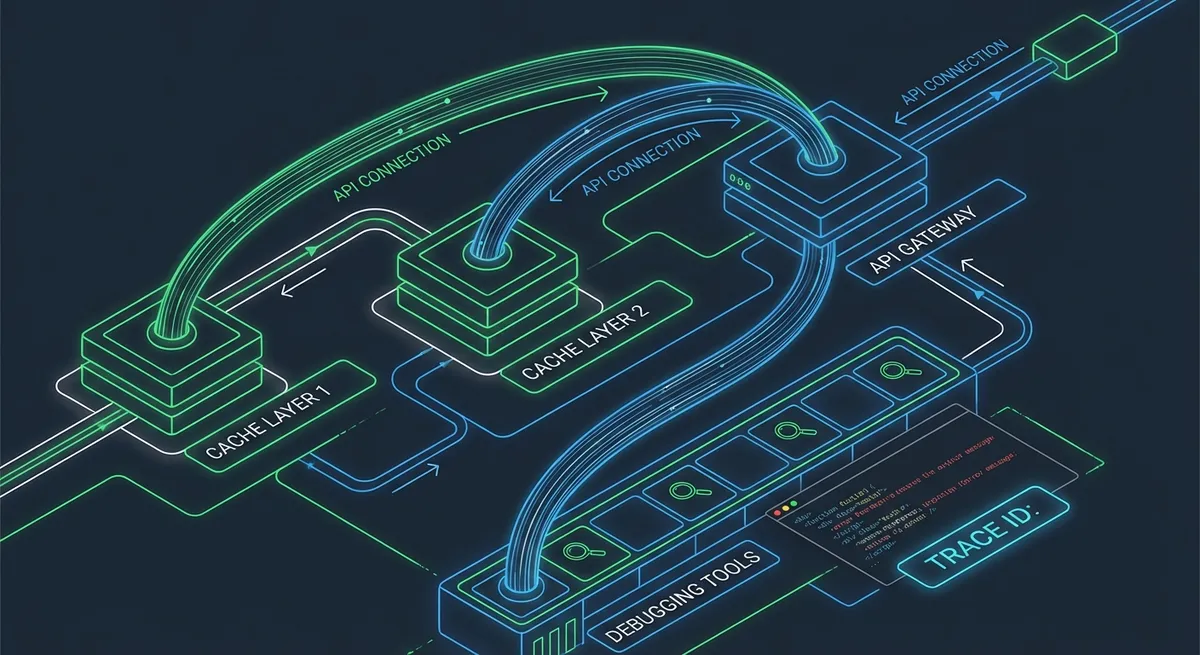
Engineering Postmortem: The Hidden Cost of Caching
If your dashboard is even occasionally stale, your team is flying blind. We shipped a two-line API cache fix and instantly reduced data staleness risk—but the real lesson is bigger: cache policy is a product decision, not just a performance trick.

Most teams talk about cache bugs as speed problems. Ours wasn’t.
It was a trust problem.
The HTS dashboard looked healthy while parts of the underlying state had already changed. We weren’t down. We were worse than down: confidently wrong. The UI rendered cleanly, operators moved fast, and decisions were made from stale responses that looked fresh.
The immediate fix was embarrassingly small: two lines that forced the route out of cache and into live fetch behavior. But if you stop the postmortem there, you miss the expensive part. Caching failures almost never hurt first through CPU or p95 latency. They hurt through delayed detection, false confidence, and wrong operational actions.
This write-up explains what happened, why two lines worked, and how to prevent this class of issue across admin surfaces and decision-critical APIs.
The short version
- We had a route in a freshness-critical path that could serve stale data.
- The dashboard consumed it without enough staleness visibility.
- Operators trusted the UI and acted on old state.
- We changed the API cache behavior (two-line fix), validated headers, and restored freshness guarantees.
- Then we added process controls so we don’t reintroduce this silently.
Why this class of bug is dangerous
Caching is a force multiplier. Done right, it cuts latency, saves origin cost, and protects availability. Done wrong, it creates modal behavior where the system appears healthy until it abruptly isn’t. AWS explicitly warns that cache downsides can outweigh the upside when teams skip rigorous operation and resilience testing.
Meta’s cache consistency work makes the same point from a different angle: stale cache divergence can be indistinguishable from data loss from a user perspective. That’s not theoretical. If your source of truth says state=failed and your cache says state=ok, your operators will execute the wrong runbook with total confidence.
Google SRE frames these incidents as cascade risks: small local failures spread through control loops and overloaded fallbacks faster than teams expect. In dashboard-heavy workflows, stale status becomes one of those loops.
What failed in our design
1) We treated a decision surface like a brochure page
Not all reads are equal. Stale-while-revalidate is often great for content where “a bit old” is acceptable. web.dev explains this pattern clearly: serve stale quickly, refresh in background.
That tradeoff is wrong for operational state. Dashboards used for triage, rollout, approvals, or incident handling need hard freshness guarantees, not best-effort freshness.
2) Cache policy was implicit
When cache behavior is implicit, every layer invents defaults: framework runtime, CDN, browser, intermediary proxies. RFC 9111 is clear: HTTP caching behavior is driven by explicit directives and validation semantics.
If you don’t set them intentionally, you still get caching—you just get surprise caching.
3) We lacked a “freshness SLO” mindset
We had uptime indicators and latency metrics. We didn’t have a clear freshness budget for this endpoint (for example, max tolerated staleness window) visible to operators.
That’s how stale bugs survive: they sit in the blind spot between “service is up” and “data is correct.”
The two-line fix (and why it worked)
We forced the affected route into no-store/no-cache behavior at the API layer and ensured live fetch semantics for the dashboard path.
Conceptually, the fix did two things:
- Disabled storage/reuse for that response path.
- Required revalidation / fresh retrieval rather than trusting old entries.
Those semantics map directly to RFC 9111 and common Cache-Control directives documented by MDN (no-store, no-cache, must-revalidate, etc.).
The code change was tiny because we were fixing policy, not business logic.
Why tiny fixes often hide large costs
The bug was simple. The blast radius wasn’t.
Uptime Institute’s 2024 analysis reports that 54% of respondents said their most recent significant outage cost more than $100,000, and 16% reported more than $1 million. Even when your incident is “just stale cache,” you still burn real money through misrouted engineering time, delayed mitigation, customer confusion, and post-incident cleanup.
The hidden cost model usually looks like this:
- Detection lag: no hard signal that data is stale.
- Decision lag: teams trust wrong telemetry.
- Recovery lag: root cause points to infra policy, not app logic, so ownership is fuzzy.
- Reputation drag: users saw contradictory statuses and confidence drops.
The fix may be two lines. The organizational tax is not.
The postmortem framework we now use
1) Classify endpoint criticality before choosing cache strategy
Use three buckets:
- Hard-fresh: no stale tolerated (admin decisions, billing, auth, compliance state).
- Soft-fresh: bounded stale tolerated (analytics summaries, non-blocking counters).
- Static-friendly: long TTL and aggressive caching (docs, media, evergreen pages).
Only soft/static endpoints should use stale-serving patterns by default.
2) Make cache behavior explicit in every critical endpoint
For hard-fresh endpoints:
- Set strict Cache-Control policy (
no-storeor equivalent hard constraints). - Validate intermediary behavior end-to-end.
- Verify browser, edge, and framework behavior matches intent.
Cloudflare’s purge docs are a useful reminder: invalidation operations are rate-limited by token-bucket controls and account limits. Translation: don’t depend on emergency purge volume as your primary consistency strategy.
3) Add freshness observability
Track freshness directly, not just uptime:
- age of data shown to operator
- source timestamp vs render timestamp delta
- cache hit/miss by endpoint criticality
- stale serve count in critical surfaces (target = 0)
If stale data is a risk, make it a first-class metric.
4) Design fallback behavior explicitly
AWS recommends resiliency planning for cache unavailability (cold starts, outages, traffic shifts) and load tests with caches disabled. We now run controlled “cache-off” tests for critical routes before rollout.
5) Version your cached objects where caching is unavoidable
Meta’s consistency guidance highlights ordering races and why version-awareness prevents older values from overwriting newer state. If you must cache mutable objects, carry version metadata and reject out-of-order writes.
GEO + SEO + AEO implementation for this post
To make this article retrievable in both search and LLM answer surfaces, we intentionally included:
- answer-first opening in first lines
- explicit definitions of hard-fresh vs soft-fresh paths
- claim-evidence proximity with source references
- visible FAQ section for answer engines
- structured internal link anchors in social package for distribution context
This is important because engineering postmortems are often high-value but under-structured. Better structure means better retrieval and fewer repeated incidents.
What changed after the fix
- Dashboard route now respects hard-fresh policy.
- Stale response risk on this path was materially reduced.
- We introduced a cache policy checklist in pre-ship review for decision-critical endpoints.
- We added an evidence map requirement so claims and controls are tied to external references.
In plain English: we moved from “hope it’s fresh” to “prove it’s fresh.”
The implementation checklist we now enforce
Before shipping any endpoint used for operations, we require five concrete checks:
- Header audit: Capture real response headers from production-like env and verify they match intended policy.
- Layer audit: Confirm framework-level caching and edge/CDN behavior are aligned (no hidden defaults).
- Staleness test: Mutate source-of-truth, then assert dashboard reflects change inside defined freshness window.
- Failure-mode test: Simulate downstream errors and confirm no stale value is presented as current truth.
- Runbook update: Add remediation notes so incidents aren’t debugged from scratch under pressure.
This took less than a day to formalize and has already paid off by catching one regression in review before it reached production.
Anti-patterns to avoid next
- Global caching defaults applied to admin APIs.
- Relying on manual purge during incidents.
- No visible timestamp provenance in dashboards.
- Treating cache bugs as frontend glitches.
- Skipping cache-off load tests before launch.
The operating principle going forward
Cache policy is not an optimization detail. It is part of correctness.
If an endpoint influences human decisions, freshness is part of the contract. The contract must be explicit, observable, and tested.
Two lines fixed our immediate issue. The real win was changing the mental model.
Conclusion
Building robust AI and infrastructure systems requires careful planning. We expect these trends to accelerate as tools mature and reduce technical friction.
Key Takeaways
- The core problem was a "trust problem" where stale cached data was presented as fresh, leading to confidently wrong operational decisions.
- A healthy-looking UI displaying outdated information caused operators to act on old state, making the situation worse than being down.
- The immediate technical fix was simple, but the true cost of caching failures stems from delayed detection, false confidence, and incorrect operational actions, not just performance.
- Caching failures are dangerous because they create a false sense of system health, leading to abrupt and unexpected issues.
- Preventing such issues requires both technical fixes (e.g
Conclusion
Building robust AI and infrastructure systems requires careful planning. We expect these trends to accelerate as tools mature and reduce technical friction.
Frequently Asked Questions
What was the core problem identified in the postmortem, and why was it worse than a typical speed issue?
The core problem wasn't speed, but a 'trust problem.' The HTS dashboard displayed healthy data while the underlying state was stale, leading operators to make confidently wrong decisions based on outdated information. This was worse than being down because the system appeared functional, fostering false confidence.
What was the immediate technical fix for the caching issue?
The immediate fix was a small, two-line code change that forced the affected route out of cache and into live fetch behavior, thereby restoring freshness guarantees for the critical data.
Why are caching bugs that lead to stale data considered particularly dangerous?
This class of bug is dangerous because it creates false confidence, leading operators to take incorrect actions based on outdated information. It can cause cascade risks, where small local failures spread rapidly through control loops, and from a user's perspective, stale cache divergence can be indistinguishable from data loss.
What were the main design failures that contributed to this incident?
The main design failures were: 1) Treating a decision-critical surface (like an operational dashboard) like a brochure page where stale data is acceptable. 2) Having an implicit cache policy, which led to 'surprise caching' across various layers. 3) Lacking a clear 'freshness SLO' (Service Level Objective) for critical data paths.
How can teams prevent the reintroduction of this class of caching issue?
To prevent reintroduction, teams should establish hard freshness guarantees for decision-critical surfaces, explicitly define cache policies using HTTP directives (as per RFC 9111), validate headers to ensure freshness, and implement process controls to prevent silent reintroduction of implicit or incorrect caching behaviors.
Sources

Written by
OptijaraHamza Diaz is the founder of Optijara, where he builds practical AI agents, automation systems, and Copilot workflows for service businesses. He writes about AI operations, agent strategy, and real-world implementation for teams that want usable systems instead of hype.