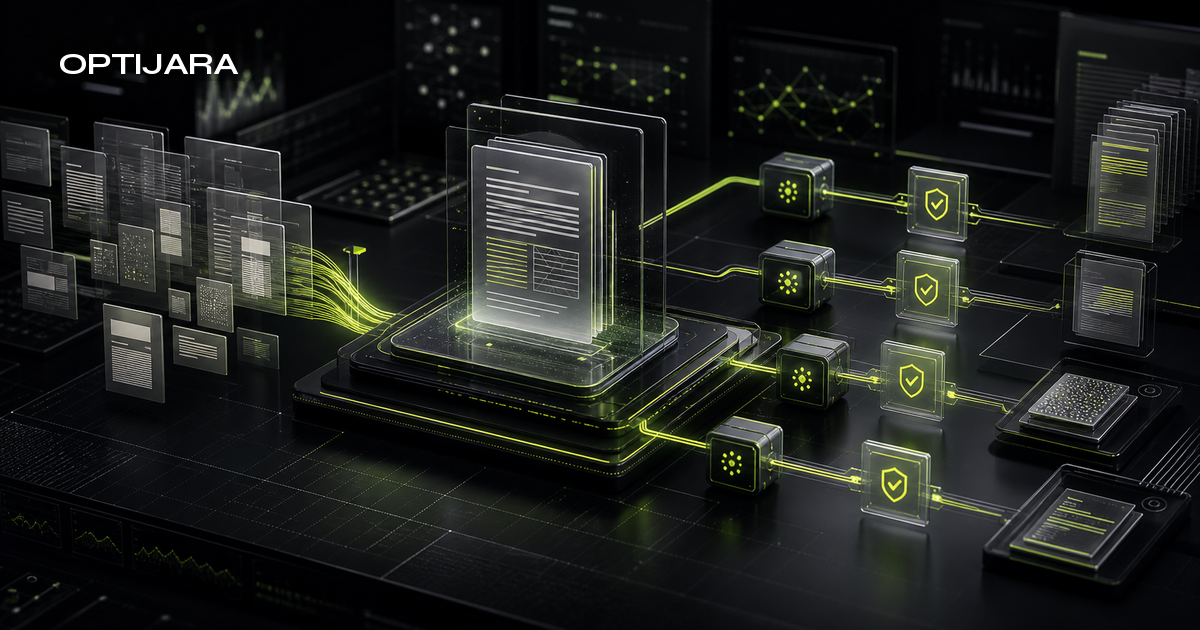
Mistral OCR 4 and the Evidence-Preserving Document AI Test Bench
Mistral OCR 4 style document parsing is a reason to reassess OCR architecture, not a reason to remove controls. This operator guide shows what to test before replacing multi-stage OCR pipelines with grounded, confidence-scored document AI.

If a document AI system extracts a value but cannot show the page, source snippet, table relationship, and confidence trail behind it, it is not ready for high-trust automation. The risky failure is not only garbled text. It is a tidy answer with weak evidence behind it. That is why a Mistral OCR 4 document AI test bench belongs before any plan to replace a working OCR pipeline.
Mistral OCR 4, and the wider move toward grounded document parsing, gives operators a fair reason to revisit OCR architecture. Mistral lists OCR 4 among its specialist models, and Mistral's OCR announcement describes an OCR API for PDFs and images that extracts ordered interleaved text and images while handling text, tables, media, and equations. Mistral's Document AI documentation describes OCR processing through client libraries and the https://api.mistral.ai/v1/ocr endpoint, with related services for OCR, annotations, and document question answering. Useful, yes. A reason to remove ingestion, layout, validation, review, and audit controls without testing, no.
The question is not whether a new parser looks better in a demo. The question is whether it preserves enough evidence for a real workflow to trust, audit, route, and correct its output. Document parsing deserves discipline because PDFs, scans, tables, and forms often become operational records, not chat context.
Why evidence preservation matters before replacing OCR pipelines
Traditional OCR was mostly about turning page images into text. Modern document AI tries to recover more of the document itself: reading order, structure, tables, images, equations, forms, and fields that downstream systems can use. That changes the operating model. A parser that returns richer structure can remove some glue code. It can also hide more risk inside one model response. If the output loses table boundaries, links a label to the wrong value, or drops the source location for a field, the downstream workflow may look cleaner while becoming harder to audit.
Evidence-preserving document AI means each extracted field, table cell, and summary stays tied to the source document. A practical minimum is document id, page number, source snippet, structural label, confidence signal, validation status, and, where the API or wrapper supports it, a bounding region. For higher-risk workflows, add reviewer decisions, model version, preprocessing steps, and the prompt or API configuration used at extraction time.
Existing OCR stacks usually contain years of unglamorous work: file normalization, duplicate detection, template rules, table validators, reviewer queues, exception handling, and audit logs. Do not throw that away because a new parser returns nicer first-pass structure. Keep the parts that expose uncertainty. Keep deterministic rules that catch impossible totals, invalid dates, missing signatures, or mismatched identifiers. A grounded OCR 4 style parser may become the extraction layer, but production quality still depends on validation, routing, and measurement.
The old stack versus OCR 4 style grounded parsing
A conventional pipeline separates ingestion, OCR, layout analysis, table detection, entity extraction, validation, review, and storage. It can be slow to modify, but every stage is inspectable. Teams can replace a weak table detector without rewriting the whole ingestion system.
The newer pattern asks a document model to return text, structure, table relationships, image references, page anchors, and sometimes fields or annotations in fewer steps. That can simplify operations, especially when the old stack struggles with mixed text, images, equations, or multi-column layouts. Ai2's olmOCR work is a useful independent reminder of why the problem is still hard. PDFs are designed to render fixed pages and do not always preserve logical reading order, headings, tables, equations, or clean paragraph boundaries. The Library of Congress format description similarly describes PDF as a formatted, page-oriented document family that may contain text, images, graphics, annotations, metadata, links, and bookmarks.
| Area | Multi-stage OCR stack | OCR 4 style grounded parsing | Operator risk to test |
|---|---|---|---|
| Layout | Separate layout model or rules | Model returns structure with text | Reading order errors can be hidden |
| Tables | Dedicated table detector | Tables may arrive as markdown or JSON | Merged cells and headers may flatten |
| Evidence | Often stored across stages | Must be captured from model output or wrapper | Citations can be lost downstream |
| Confidence | Component-specific scores | Model or wrapper confidence | One score can mislead reviewers |
| Exceptions | Usually explicit queues | Must be designed deliberately | Low-confidence cases may pass silently |
| Change control | Many components to version | Fewer visible moving parts | Model updates can shift behavior |
My opinion: fewer stages are only an improvement when they reduce operational risk, not just diagram clutter. A two-box architecture that cannot explain its answers is worse than an awkward pipeline that can.
The Optijara Evidence-Preserving Document AI Test Bench
The Optijara Evidence-Preserving Document AI Test Bench is a repeatable evaluation method for deciding whether a grounded parser should replace, wrap, or sit beside an existing OCR pipeline. It has five layers: corpus design, extraction tasks, evidence checks, confidence calibration, and operational routing.
{
  "framework": "Optijara Evidence-Preserving Document AI Test Bench",
  "layers": ["corpus_design", "extraction_tasks", "evidence_checks", "confidence_calibration", "operational_routing"],
  "minimum_evidence": ["document_id", "page", "snippet", "region", "field_label", "confidence_component", "review_status"],
  "decision": ["replace", "wrap", "keep_existing_pipeline"]
}
Start with a representative corpus. Include born-digital PDFs, scanned PDFs, low-resolution scans, rotated pages, dense tables, multi-column reports, handwritten notes, multilingual pages, forms, contracts, and mixed image-text documents. Each sample needs ground truth for expected text spans, table cells, reading order, page anchors, accepted alternates, and known ambiguity notes.
Do not start with summaries. Test whether the parser preserves structure first. A summary can sound plausible while skipping a footnote, merging two columns, or treating a caption as body text. The W3C WCAG guidance on information and relationships is useful here because it stresses that visual structure should be programmatically determinable or available in text. That does not mean a parser makes a document accessible. It means relationships matter.
Uncertainty should change workflow behavior. A missing page anchor, conflicting table total, low OCR confidence, unsupported language, or sensitive document class should trigger fallback, human review, or stricter validation. Benchmarks such as olmOCR and related document parsing evaluations provide external context, but they cannot replace workload-specific testing. Acceptance criteria should reflect the documents and decisions the system actually handles.
What to test before migration
Test multi-column pages, footnotes, captions, headers, repeated page furniture, sidebars, and tagged PDFs where available. A parser can extract every word and still produce the wrong meaning if reading order breaks.
Tables need their own test set. Check row headers, column headers, merged cells, totals, units, empty cells, nested tables, and continued tables across pages. If downstream systems consume JSON, verify that the JSON preserves enough evidence to audit each field. Every extracted value used in a workflow should carry page number, source snippet, and region reference where supported. If exact bounding boxes are unavailable, store the closest reliable anchor and make the limitation visible.
Separate model confidence, rule validation, retrieval confidence, human-review status, and business risk. A high model score does not prove that a value passed domain validation. A low score may still be acceptable for a low-risk routing decision. Calibrate confidence against ground truth, then map bands to actions.
Include mixed languages, different scripts, stamps, signatures, marginal notes, low contrast scans, compression artifacts, skew, rotation, and handwriting. Ai2's olmOCR examples include handwriting and complex layouts as real document parsing cases. A pilot should include the messy documents users actually submit.
Measure per-page costs, token or image processing effects where applicable, retry behavior, queue time, human review volume, storage overhead, and regression testing cost. Mistral's original OCR announcement included page-based pricing details for its OCR API at launch, but production cost depends on document size, batching, retries, review rate, and integration design, so current pricing should be checked before procurement.
| Test dimension | Example acceptance check | Failure route |
|---|---|---|
| Reading order | Paragraphs, captions, and footnotes appear in expected sequence | Human review or alternate parser |
| Table structure | Headers, units, totals, and merged cells survive JSON conversion | Table-specific validator |
| Evidence | Each accepted field has page, snippet, and region or anchor | Reject automation for that field |
| Confidence | Scores are calibrated against ground truth | Route by calibrated bands |
| Multilingual scans | Mixed scripts retain labels and values | Language-specific review |
| Latency | Processing fits queue and service design | Batch, cache, or keep current path |
Decision matrix: replace, wrap, or keep the existing OCR pipeline
Replacement is reasonable only when representative documents pass evidence, accuracy, routing, security, and operational tests. Good candidates usually have variable layouts where the old template stack is expensive to maintain, but where source evidence can still be preserved.
Wrapping is often the safer first move. Use the newer parser to produce richer structure, page anchors, and candidate fields, then keep existing validators, schemas, and review queues. This works well when downstream systems already depend on stable records.
Keep the existing pipeline when templates are stable, deterministic rules are operationally required, edge-case handwriting dominates, model outputs cannot be audited, or data-handling requirements are unresolved. Migration is an engineering decision, not a model announcement decision.
| Condition | Replace | Wrap | Keep |
|---|---|---|---|
| High document variability | Yes | Yes | Maybe |
| Strict citation traceability | Only if proven | Yes | Yes |
| Complex tables | Maybe | Yes | Maybe |
| Tight latency budget | Maybe | Maybe | Yes |
| Strong legacy rules | No | Yes | Yes |
| Limited review capacity | Only with calibrated routing | Maybe | Maybe |
Implementation checklist for a safe pilot
Build a document corpus that samples real diversity without exposing unnecessary sensitive data. Include clean files, hard negatives, degraded scans, rotated pages, handwritten notes, multi-language pages, and documents that should fail automation. Create ground truth for fields, tables, page anchors, accepted variations, reading order, and impossible cases. Decide what must be exact and what can tolerate equivalent wording.
Design the evidence schema before the first integration. Store document id, page, region, snippet, extracted value, confidence components, validation status, model version, prompt or API config, preprocessing, postprocessing, and reviewer decision. Then run the parser in shadow mode. Compare it with the current pipeline without changing production decisions. Review disagreements, missing evidence, false confidence, and documents that require fallback.
Add fallback and human review paths before launch. Route low-confidence, conflicting, missing-evidence, sensitive, or high-value cases to existing OCR, rules, or human review. Record reviewer feedback so regressions are visible.
Common mistakes that break document AI pilots
Clean PDFs hide the failures that matter: scans, rotations, handwriting, multilingual pages, and low-quality exports. Include real mess early. Flattening tables can destroy row and column relationships. If a workflow depends on totals, units, headers, or line items, test table structure as data, not prose.
Confidence is not a verdict. It should influence routing alongside validation rules, citation coverage, field importance, and reviewer history. Citations and bounding references must be saved at extraction time. They are difficult to reconstruct after transformation, summarization, indexing, or record updates. Summaries are views. They are not the system of record. Preserve source text, structured fields, evidence, and reviewer decisions separately.
Caveats, limitations, and measurement plan
Review data retention, access controls, encryption, audit logs, redaction strategy, and whether processing locations match requirements before uploading representative documents. APIs, model versions, confidence outputs, page limits, and supported file types can change. Use adapter layers, versioned configs, and regression tests. Cached OCR or parsed JSON can become stale when documents are corrected, preprocessing changes, or a model version shifts. Store enough version history to reproduce decisions.
| Metric | Why it matters | Review cadence |
|---|---|---|
| Citation coverage | Shows whether accepted outputs are traceable | Every pilot batch |
| Table cell accuracy | Captures structure errors hidden by plain text | Every table-heavy batch |
| Calibration error | Tests whether confidence maps to reality | After each corpus update |
| Exception rate | Reveals operational load | Weekly during shadow mode |
| Regression rate | Catches model or config drift | Before rollout and after changes |
Keep the scorecard small enough to use:
{
  "corpus_slice": "multilingual_scanned_forms",
  "task": "extract_fields_with_page_evidence",
  "expected_evidence": ["page", "snippet", "region", "field_label"],
  "pass_threshold": "defined_by_ground_truth_acceptance_criteria",
  "observed_issue": "merged_cells_lost_in_json",
  "routing_action": "human_review_and_table_validator",
  "owner": "document_ai_pilot_team"
}
Migration guidance: from pilot to production
Start small with a diverse diagnostic set. The goal is not a launch decision. It is to reveal obvious gaps in layout, tables, citations, confidence, and routing. Then run a larger representative shadow test. Compare the new parser with the existing pipeline, reviewers, and ground truth. Track disagreements and classify each issue as extraction, evidence, validation, routing, or integration.
Start production with low-risk document classes. Keep fallback paths. Monitor drift. Require reviewer feedback loops. Define rollback triggers before production, such as missing evidence on accepted fields, table regression, unsupported document classes, or cost and latency outside planned bounds.
A consultant can help design the test bench, evidence schema, shadow-mode migration plan, and measurement loop. The decision should still be conservative: a document AI system is ready when it preserves evidence, exposes uncertainty, and routes exceptions instead of hiding them.
Key Takeaways
- 1Do not replace an OCR pipeline unless extracted values remain traceable to pages, snippets, regions, confidence signals, and review status.
- 2Mistral OCR 4 style parsing can simplify document workflows, but it concentrates evaluation and routing risk inside model output.
- 3The Optijara Evidence-Preserving Document AI Test Bench evaluates corpus design, extraction tasks, evidence checks, confidence calibration, and operational routing.
- 4Tables, reading order, bounding references, multilingual scans, handwriting, cost, latency, and fallback behavior should be tested before migration.
- 5Confidence scores should route exceptions, not replace validation or human review by default.
- 6Many teams should wrap a grounded parser around existing validators before fully replacing a multi-stage OCR stack.
Conclusion
The best document AI migrations are not driven by launch posts or demo screenshots. They are driven by evidence. Before replacing a multi-stage OCR pipeline, test whether the new parser preserves source context, exposes uncertainty, survives messy documents, and routes exceptions in a way operators can defend.
Frequently Asked Questions
What is evidence-preserving document AI?
It is a document processing approach where extracted text, fields, tables, and summaries remain linked to source pages, regions, snippets, confidence signals, validation status, and reviewer decisions so teams can audit how an output was produced.
How is Mistral OCR 4 different from a traditional OCR pipeline?
Traditional pipelines often separate OCR, layout analysis, table extraction, entity extraction, validation, and review. OCR 4 style parsing can return richer structure and grounding in fewer steps, but it still needs evidence checks, confidence calibration, and failure routing.
What should teams test before replacing an OCR pipeline?
They should test reading order, table structure, bounding regions, citation traceability, confidence calibration, multilingual and noisy scans, handwriting, latency, cost, security, and fallback behavior on representative documents.
Can confidence scores replace human review?
No. Confidence scores should help route work. Teams still need calibration against ground truth, validation rules, evidence coverage checks, and human review for uncertain or high-risk cases.
When should teams keep a multi-stage OCR pipeline?
They should keep or wrap the existing pipeline when deterministic rules, legacy schemas, strict audit needs, specialized handwriting, sensitive data handling, or proven template performance outweigh the benefits of end-to-end parsing.
Sources
- https://mistral.ai/news/mistral-ocr/
- https://mistral.ai/models/
- https://docs.mistral.ai/studio-api/document-processing/overview
- https://docs.mistral.ai/api#tag/ocr
- https://allenai.org/blog/olmocr
- https://www.w3.org/WAI/WCAG22/Understanding/info-and-relationships.html
- https://www.loc.gov/preservation/digital/formats/fdd/fdd000030.shtml

Written by
Hamza DiazHamza Diaz is the founder of Optijara, where he builds practical AI agents, automation systems, and Copilot workflows for service businesses. He writes about AI operations, agent strategy, and real-world implementation for teams that want usable systems instead of hype.