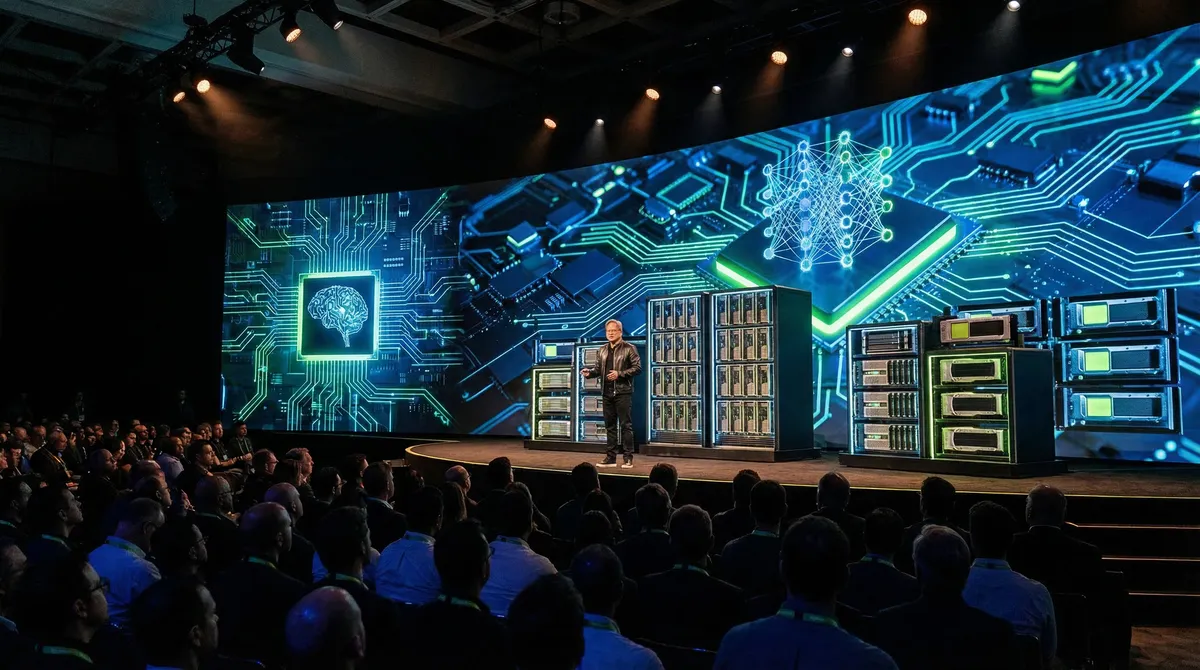
NVIDIA GTC 2026: what developers and founders should watch
NVIDIA GTC 2026 kicks off March 16 with a focus on NemoClaw, agentic AI infrastructure, and the shift to inference. This guide covers the key sessions, rumored announcements, and strategic shifts that developers and founders need to know.

NVIDIA GTC 2026 starts tomorrow with Jensen Huang's keynote at the SAP Center in San Jose. The three-day conference runs March 16–19, draws 30,000 attendees from 190 countries, and typically sets the direction for AI infrastructure for the year ahead. Here is what developers, founders, and technical leaders should be watching.
What is GTC and why it matters this year
GTC (GPU Technology Conference) is NVIDIA's annual flagship event where new hardware, software platforms, and AI frameworks get announced. It matters more than usual in 2026 because the AI industry is shifting from model training to inference and deployment. NVIDIA's announcements here will likely shape how companies build and run AI systems for the next 12–18 months.
The keynote streams free at nvidia.com/gtc/keynote on Monday, March 16 at 11 a.m. PT (8 p.m. CET). Huang typically speaks for about two hours.
NemoClaw: NVIDIA's rumored enterprise AI agent platform
According to Wired and TechCrunch reporting, NVIDIA is expected to announce NemoClaw — an open-source platform for enterprise AI agents. The name suggests a merger of NVIDIA's existing NeMo framework (used for training and fine-tuning large language models) with the always-on agent paradigm that has gained traction through projects like OpenClaw.
If confirmed, NemoClaw would provide enterprise teams with a standardized way to deploy autonomous AI agents that run continuously, use tools, and complete multi-step workflows. This is different from the batch-processing approach most companies still use with LLMs.
For founders and CTOs evaluating AI agent infrastructure, the key question is whether NemoClaw competes with existing frameworks like LangChain and CrewAI or integrates alongside them. The open-source designation, if accurate, suggests NVIDIA wants to become the infrastructure layer rather than the application layer.
Agentic AI takes center stage
Agentic AI is one of five core tracks at GTC 2026. The pre-keynote panel features LangChain CEO Harrison Chase, PrimeIntellect CEO Vincent Weisser, and OpenClaw creator Peter Steinberger discussing systems that reason step by step, use tools, and complete complex tasks without constant human input.
The distinction between a chatbot and an agent is now well-understood: agents maintain state, make decisions across multiple steps, invoke external tools, and operate with minimal supervision. GTC 2026 is expected to address the infrastructure gaps that currently make production agent deployment difficult — specifically around reliability, observability, and cost management.
For builders, the sessions to prioritize are those focused on agent orchestration patterns, tool-use optimization, and the emerging "token generation as a unit of computing" framework that several GTC speakers have referenced.
Open models vs. closed frontier models
Wednesday's panel, moderated by Huang himself, features Harrison Chase (LangChain), leaders from A16Z, AI2, Cursor, and Thinking Machines Lab. The topic: where open models stand against closed frontier models like GPT-5.4 and Claude Opus 4.
This debate is particularly relevant in March 2026 because open models have made significant gains. Alibaba's Qwen 3.5 Small 9B model now matches models 13 times its size on key benchmarks. Meta continues to push Llama forward. Mistral CEO Arthur Mensch is also speaking at the pre-keynote event.
The practical implication for developers: the gap between open and closed models is narrowing faster than most predicted, especially for specific use cases. Companies running on-device or in air-gapped environments now have production-quality options that did not exist six months ago.
Physical AI and robotics
GTC 2026 dedicates significant floor space to physical AI — where simulation, digital twins, and foundation models move from virtual training into real-world deployment. Speakers include Waabi CEO Raquel Urtasun (autonomous vehicles), SkildAI CEO Deepak Pathak (general-purpose robotics), and PhysicsX CEO Jacomo Corbo (industrial simulation).
NVIDIA's Omniverse platform and Isaac robotics framework are expected to receive major updates. The company's strategy has been consistent: provide the simulation environment where robots learn, then sell the hardware they run on.
For founders outside robotics, the physical AI track still matters because the same simulation and digital twin technologies apply to manufacturing, logistics, energy, and construction.
AI infrastructure at scale
The infrastructure panel features some of the biggest names in cloud and enterprise computing: Dell CEO Michael Dell, CoreWeave CEO Michael Intrator, and Caterpillar CEO Joe Creed. The focus is on what it takes to build and power AI systems at production scale.
Key themes expected include power and cooling challenges for large GPU clusters, the shift from training-dominant to inference-dominant workloads, and how "token generation" is emerging as a new fundamental unit of computing — similar to how FLOPS defined previous computing eras.
CoreWeave's presence is notable because the company has grown rapidly as a GPU cloud provider specifically for AI workloads. Their perspective on infrastructure economics will be relevant for any startup deciding between building their own GPU cluster, renting from hyperscalers, or using specialized providers.
DGX Spark and local-first AI
NVIDIA's DGX Spark represents a bet on local-first AI computing. At GTC, the company is running a "build-a-claw" workshop where attendees can deploy always-on AI agents running on local hardware — either DGX Spark, Jetson modules, or GeForce RTX laptops.
The pitch is straightforward: always-on AI assistants that work directly with your files, apps, and workflows without relying on cloud APIs. For developers concerned about latency, data privacy, or API costs, local-first agents are an increasingly viable option.
NVIDIA has also published an OpenClaw Playbook — a step-by-step guide to running OpenClaw on DGX Spark. This signals that NVIDIA sees the always-on agent pattern as a primary use case for their local AI hardware.
What to watch for in the keynote
Jensen Huang's keynotes follow a pattern: start with infrastructure (chips, systems), move to software platforms, then demonstrate applications. Based on pre-event signals, here are the specific announcements to watch for:
- New GPU architecture details or roadmap updates beyond Blackwell
- NemoClaw or equivalent enterprise agent platform
- Inference optimization announcements (given the industry shift from training to deployment)
- Partnerships with cloud providers for AI infrastructure
- Updates to NeMo, Omniverse, and Isaac platforms
- Any announcements related to AI regulation or safety frameworks
How to follow GTC 2026 remotely
The keynote livestream is free at nvidia.com/gtc/keynote starting Monday March 16 at 11 a.m. PT. The GTC Developer Community Livestream on March 18 covers show floor demos and interviews. NVIDIA's blog at blogs.nvidia.com/blog/gtc-2026-news provides rolling updates.
For the pre-keynote show, tune in at 8 a.m. PT on Monday. Hosts include Sarah Guo (Conviction), Gavin Baker (Atreides Management), and Alfred Lin (Sequoia Capital).
Conclusion
GTC 2026 marks a pivotal shift from AI model training to real-world inference and autonomous agents. Between the rumored NemoClaw for enterprise automation, DGX Spark for local-first computing, and the accelerating open-vs-closed model debate, this week will set the technical and economic tone for AI infrastructure through the rest of the year. Developers and founders should pay close attention to which tools move into production and how NVIDIA's software stack integrates with existing agent frameworks.
Key Takeaways
- NVIDIA GTC 2026, a three-day conference drawing 30,
Conclusion
GTC 2026 marks a pivotal shift from AI model training to real-world inference and autonomous agents. Between the rumored NemoClaw for enterprise automation, DGX Spark for local-first computing, and the accelerating open-vs-closed model debate, this week will set the technical and economic tone for AI infrastructure through the rest of the year. Developers and founders should pay close attention to which tools move into production and how NVIDIA's software stack integrates with existing agent frameworks.
Frequently Asked Questions
When is the NVIDIA GTC 2026 keynote?
Jensen Huang's keynote is scheduled for Monday, March 16, 2026 at 11 a.m. PT (2 p.m. ET / 8 p.m. CET). The pre-show starts at 8 a.m. PT. Both are available via free livestream at nvidia.com/gtc/keynote.
What is NemoClaw?
NemoClaw is a rumored open-source platform from NVIDIA for building and deploying enterprise AI agents. First reported by Wired and covered by TechCrunch, it appears to combine NVIDIA's NeMo framework with always-on agent capabilities. Official confirmation is expected during the GTC keynote.
Is GTC 2026 free to attend virtually?
The keynote livestream is free. Some GTC sessions are available to virtual registrants, though certain workshops and hands-on labs require paid registration. Check nvidia.com/gtc for current registration tiers.
What AI hardware announcements are expected at GTC 2026?
Pre-event reporting suggests updates to NVIDIA's GPU roadmap, new inference-optimized configurations, and expanded availability of DGX Spark for local AI deployment. Specific chip architecture announcements typically happen during the keynote.
How does GTC 2026 differ from previous years?
The 2026 conference places significantly more emphasis on inference (running models) versus training (building models), reflecting where the industry has moved. Agentic AI and physical AI are elevated to primary tracks, and the open vs. closed model debate gets dedicated keynote-level attention.
Sources
- https://blogs.nvidia.com/blog/gtc-2026-news/
- https://techcrunch.com/2026/03/12/how-to-watch-jensen-huangs-nvidia-gtc-2026-keynote/
- https://www.nvidia.com/gtc/keynote/
- https://www.analyticsinsight.net/news/nvidia-gtc-2026-keynote-major-announcements-on-ai-gaming-cpus-and-computing
- https://www.gadgets360.com/how-to/news/nvidia-gtc-2026-how-to-watch-jensen-huang-keynote-what-to-expect-11217325

Written by
OptijaraHamza Diaz is the founder of Optijara, where he builds practical AI agents, automation systems, and Copilot workflows for service businesses. He writes about AI operations, agent strategy, and real-world implementation for teams that want usable systems instead of hype.