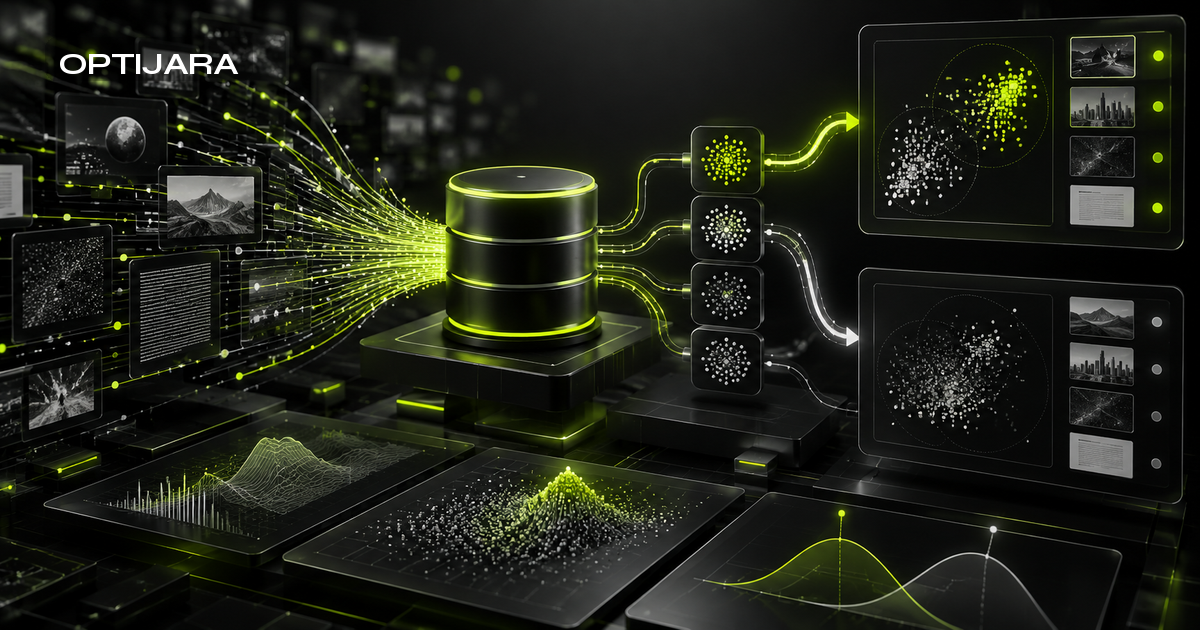
Qdrant Supernova Benchmark: FineWeb-10B Recall Is Not Relevance
Matching an exact vector ranking does not prove that retrieved passages answer the question. Use the Benchmark Fidelity Ladder to design bounded Supernova experiments with shard-specific ground truth, comparable operating conditions and separate relevance checks.

What a Qdrant Supernova benchmark can actually prove
A Qdrant Supernova benchmark can tell you whether a vector system reproduces a defined neighbor ranking under known conditions. That is useful. It is also narrower than many teams want it to be.
Exact-neighbor recall is not human relevance, and it is not answer correctness. With FineWeb-10B, the serious work starts before any database comparison. You have to define the workload, preserve its identity, and make the scoring rule auditable. Otherwise the benchmark becomes a polished way to compare mismatched experiments.
Here is the practical problem. A retrieval system can return the passages closest to a question embedding and still miss the passage that answers the question. The ranking can be faithful to the embedding space while the application gives the user a weak answer. That is not a small caveat. It is the line between a vector benchmark and a RAG evaluation.
Neighbor fidelity, human relevance and answer correctness
Treat these as different targets.
Neighbor recall measures agreement with an exact reference for a specified representation, metric, filter and cutoff. Human relevance asks whether the retrieved material helps with the information need. Answer correctness asks whether the final response is accurate and supported by the retrieved evidence.
Qdrant's release announcement reports 10.07B dense and 10.07B sparse vectors. The FineWeb-10B card describes exact top-1000 references and 100,000 dense queries, plus separate sparse and filtered query sets. Those numbers are publisher-reported. They are not Optijara measurements.
Why this is a method, not a database leaderboard
Optijara has not downloaded the full corpus or run a full or shard benchmark for this article. This is an experimental design, not a results report.
The announcement gives the scale. The dataset card defines the data. The recall guide explains the scoring semantics. This article connects those sources into bounded experiments and a separate production validation plan. It does not claim exhaustive originality. For the related model-selection question, see the embedding retrieval acceptance test.
Map Supernova modules to benchmark artifacts
The module table
The Supernova repository and linked module documentation describe this lifecycle. The key is to treat each checkpoint as evidence to retain, not as a command you ran once and forgot.
| Module | Documented role | Retain | Operator caveat |
|---|---|---|---|
| nova-embed | Generate embeddings | Representation and generation manifest | Regeneration needs model and tokenizer pins |
| nova-bf | Compute exact neighbor references | Shard-specific reference and scoring configuration | Verify installation and arithmetic separately |
| nova-load | Prepare, load and finalize data | ID reconciliation and readiness timestamps | Successful completion must not conceal skipped files |
| nova-storm | Measure query performance and recall | Request traces and scoring semantics | Tie reporting is backend-specific |
| nova-dist | Orchestrate distributed jobs | Reviewed job and resource configuration | Inspect dry-run output before provisioning |
Pin documentation before copying commands
The documentation homepage and repository expose different command generations. Pick a commit, use that documentation, then inspect the installed CLI help. The root README installation list does not prove that nova-bf is installed. No executable command in this article has been installation-tested.
Backend support also needs care. The loading guide documents Qdrant-specific resume behavior. The recall guide documents Qdrant-specific tie reporting. Support for querying several databases does not mean every feature behaves the same way everywhere.
The Benchmark Fidelity Ladder: build the smallest valid experiment first
The Benchmark Fidelity Ladder is Optijara's proposed editorial method, not an established benchmark standard. Its rungs are a bounded shard, an exact shard reference, matched workloads, comparable operating conditions and separately judged production queries.
The opinionated version is simple: do not scale a bad experiment. A small benchmark with clean identity beats a large benchmark with hidden joins, unknown arithmetic, vague cache state and unclear scoring.
Bound the corpus and preserve its identity
Start with an immutable file list and a fixed query set. Do not rely on whatever a streaming reader happens to encounter first. Record preserved source IDs, selection seeds, dimensions, normalization, dtype, distance metric, requested cutoff, tokenizer, filter rules and tie policy.
Fingerprint corpus files, query vectors and configurations separately. Query-text checksums do not establish embedding equality, as the FineWeb-10B card warns. A query can have the same text and a different vector if the model revision, tokenizer, normalization or remote code changed.
The OpenBind reproducibility analysis covers the related gap between a benchmark label and real-world validity. Here, the manifest has one job: make the actual searched corpus recoverable.
Recompute the exact reference for that shard
Do not filter a published full-corpus top-1000 list to IDs present in your shard and call it exact shard ground truth. That shortcut loses neighbors that are valid inside the shard but never appeared in the truncated global list.
Recompute the reference over precisely the selected corpus and query vectors, using the chosen metric and filters. Keep the generation configuration beside the reference. A file named ground truth is not enough. You need to know how its scores were produced.
Match workloads before adding production questions
Use this implementation checklist before increasing scale. Each row should leave an inspectable artifact.
| Check | Required evidence |
|---|---|
| Review rights and pin inputs | Code, corpus, query, model and tokenizer revisions with permitted-use notes |
| Select and validate shard | File manifest, preserved IDs, vector checks and successful reference joins |
| Generate exact reference | Matching corpus, queries, metric, filters, cutoff and arithmetic record |
| Load and establish readiness | Reconciled loaded IDs, failure log and explicit readiness condition |
| Fix query conditions | Hardware, index settings, concurrency, query mix and cache protocol |
| Save evaluation evidence | Request traces, separate relevance judgments and stated limitations |
Design a test matrix that separates recall, relevance and operations
Dense, sparse and filtered FineWeb experiments
The FineWeb-10B card specifies unit-norm dense vectors, which support cosine or equivalent dot-product ranking. It also specifies unnormalized sparse weights evaluated with dot product. Preserve those conditions. Independent dense and sparse exact rankings are not ground truth for a hybrid fusion rule.
| Workload | Reference | Measurements | Does not establish |
|---|---|---|---|
| Dense shard | Exact matching dense ranking | Recall@k, ties and query latency | Human relevance or full-scale performance |
| Sparse shard | Exact sparse dot product | Recall@k, latency and index storage | Hybrid ranking quality |
| Text and structured filters | Exact matching filter semantics | Full-depth, short-list and no-hit behavior | Analyzer equivalence by default |
| Separate PubMed multi-vector shard | Matched token vectors and MaxSim | Representation fidelity, latency and storage | FineWeb comparability or clinical usefulness |
| Ingestion and readiness | Same loaded IDs and readiness definition | Ingest, build and end-to-ready time | Equivalent backend phase accounting |
| Permitted production queries | Human judgments and answer rubric | Ranking relevance, correctness and citation support | An unchanged official benchmark |
The brute-force guide defines text matching as lowercase word-token AND behavior, not phrase search. Match tokenization, Boolean logic, date boundaries, null handling and membership semantics. A field named keyword_phrase does not override the documented operation.
Optional matched-corpus multi-vector extension
PubMed-MV supplies dense, sparse and token-vector representations over the same abstracts. Use its documented MaxSim definition in a separately bounded experiment. Do not compare its headline results directly with FineWeb or read neighbor fidelity as clinical relevance.
Coyo-VE is another distinct workload. Its card specifies embeddings and captions, not image bytes. Neither companion dataset lets you skip corpus, query and representation identity.
Fair loading and query conditions
Fix hardware, backend versions, replication, quantization, index settings, filter indexes, concurrency and query mix. Define cold and warm cache protocols explicitly. An unspecified repeat run is not a representative cache policy.
If a local language model consumes the retrieved passages, keep its device and runtime evaluation separate from vector-engine timings. The MiniCPM5-2B deployment reality test covers that adjacent deployment question, not FineWeb search performance.
The loading guide distinguishes post-upload indexing from Elasticsearch's inline ingest-plus-index accounting. As a result, index_seconds alone is not a fair cross-backend clock. Measure the full path from setup to the same query-ready condition, while retaining backend-specific phases.
Use a measurement plan that keeps denominators and failures visible:
| Question | Record | Reporting rule |
|---|---|---|
| Did search reproduce the reference? | Recall@k, cutoff, ties and query groups | Separate full-depth, short-reference and no-hit cases |
| How did requests behave? | p50/p95/p99, request counts, throughput, failures and timeouts | Declare whether percentiles cover successes only; report failures alongside them |
| What did readiness require? | Ingestion, index/build, memory loading and end-to-ready time | Show phase boundaries and readiness definition |
| What resources were consumed? | Host RAM, GPU memory, disk, transfer and observed charges | Distinguish observations from estimates |
| Was retrieval useful? | Human relevance, answer correctness and citation support | Keep each judgment separate from neighbor recall |
For a Claude-backed RAG experiment, freeze the model identifier, prompt, retrieved passage order and generation settings. Save passage IDs and source URLs with each answer. Judge whether citations support the claims and whether the requested exception was answered. Record retrieval and generation latency separately. Label this as an application experiment, not a nova-storm result.
What teams get wrong when measuring nova-storm recall
Wrong cutoff, short lists and unequal tie treatment
Finding a returned top-10 ID anywhere in a top-1000 reference is not recall@10. Recall@10 compares the returned ranking with the corresponding exact cutoff. The current recall guide truncates deeper ground truth to top_k and identifies the changed semantics with schema_version: 2. Reconcile definitions before combining legacy and current traces.
Report short-reference queries separately from full-depth queries and specify the denominator policy. Preserve no-hit cases as operational tests. A combined mean without group sizes hides which workload was actually evaluated.
Also separate exact-ID recall from tie-tolerant bounds. Comparing Qdrant's tie-adjusted result with another backend's exact-only result changes the scoring rule. It is not merely a database difference.
Precision and loading errors disguised as search differences
There is an unresolved provenance conflict: the FineWeb-10B card describes bfloat16 ground-truth arithmetic, while the current recall documentation says nova-bf has no bf16/fp16 compute mode. Request the generation-time revision and arithmetic manifest. Do not invent a reconciliation or diagnose a database bug from this discrepancy.
Distinguish duplicate IDs, duplicate text, duplicate embeddings and tied scores. The upstream FineWeb card describes crawl-level deduplication, not guaranteed global duplicate removal.
Before tuning an index, inspect skipped files, ID forms, query-vector identity, metric and filtering. The FineWeb-10B card notes different corpus and reference identifier forms. An unexplained failed join is a data-integrity blocker, not an ANN tuning opportunity.
Caveats, query rights and resource stop criteria
Review code, corpus, query and model licenses separately
Supernova's repository declares Apache-2.0. Upstream FineWeb specifies ODC-By and additional Common Crawl terms. The gte-multilingual-base model card declares Apache-2.0 and includes remote-code-dependent examples. None of these grants blanket permission for every input.
Microsoft's MS MARCO terms specify noncommercial research use. Review query rights before adopting the published workload. Appropriately permitted first-party queries create a separately labeled experiment, not an unchanged official benchmark. Companion datasets need their own upstream-rights review.
Pin model, tokenizer and remote code. Observing a current repository revision does not prove which revision generated published artifacts. Missing generation provenance limits reproducibility claims even when files are publicly downloadable.
Stop before an invalid sample becomes an expensive run
Set project-specific ceilings for spend, elapsed time, downloaded bytes, disk, host RAM and GPU memory before execution. Stop at a ceiling, persistent load failure, failed ID join, divergent filter behavior or unexplained reference mismatch. Save the stopping reason. Do not silently shrink the workload and keep the original label.
A warm-cache shard cannot establish full-corpus cost or tail latency. Later assessments must include implementation effort, transfer, index construction, provider and hardware variance, cache state or staleness, evaluation quality and ongoing operations. Minimize private query data and keep it out of public artifacts.
Publish a reproducibility record, not a winner
A compact machine-readable summary
This summary describes the proposed experiment. Null observations are deliberate: no benchmark or cost measurement was performed.
{
  "framework": "Benchmark Fidelity Ladder",
  "scope": "proposed_bounded_experiment",
  "fullCorpusRun": false,
  "benchmarkExecuted": false,
  "recomputeGroundTruthForShard": true,
  "neighborRecallIsHumanRelevance": false,
  "humanRelevanceIsAnswerCorrectness": false,
  "observedRecall": null,
  "observedP95Ms": null,
  "observedCost": null
}
Hand off the immutable manifest, versioned configuration, load reconciliation, readiness timestamps and request traces together. Include recall semantics, tie diagnostics, query groups, latency distributions, failures, resource accounting and separate human judgments.
What to test next
First, establish a trustworthy bounded reference. Then compare matched operating conditions. After that, ask whether permitted production queries retrieve useful evidence and whether downstream answers use that evidence correctly. A valid sample justifies the next experiment. It does not justify a full-corpus performance claim.
Key Takeaways
- 1Exact-neighbor recall measures ranking fidelity, not human relevance or answer correctness.
- 2Recompute exact ground truth over the selected shard instead of filtering a truncated full-corpus reference.
- 3Pin representation, filters, arithmetic, IDs and recall semantics before comparing backends.
- 4Report end-to-ready time, latency distributions, failures and resource use under matched conditions.
- 5Review code, corpus, query and model rights independently before using benchmark components.
- 6Treat the Benchmark Fidelity Ladder as a proposed experiment design, not evidence of an executed benchmark.
Conclusion
A useful Supernova experiment makes its inputs, scoring rules and operating conditions inspectable. Establish exact shard fidelity before scaling, then evaluate production relevance and answer correctness on their own terms. For teams planning this kind of evaluation, the hard part is not running nova-storm. It is keeping the workload, evidence and claims honest from the first shard onward.
Frequently Asked Questions
What does a Qdrant Supernova benchmark measure?
It measures vector-search fidelity and operating behavior under a specified workload, including loading and query performance. Exact-neighbor recall does not measure human relevance or answer correctness. See [Supernova documentation](https://github.com/qdrant-labs/supernova).
Does FineWeb-10B exact ground truth prove answer relevance?
No. Exact references describe neighbor rankings under specified representations, metrics and filters. Useful passages and correct answers require separate judgments. See the [FineWeb-10B card](https://huggingface.co/datasets/Qdrant/FineWeb-10B).
Can I benchmark a small FineWeb-10B shard?
Yes, as a separately labeled experiment with permitted queries, preserved IDs and exact ground truth recomputed over that shard. Filtering a truncated full-corpus neighbor list is insufficient. See the [reference computation guide](https://github.com/qdrant-labs/supernova/blob/master/docs/brute-force/overview.md).
Why is matching any top-1000 neighbor not recall@10?
Recall@10 compares the returned ranking with the corresponding exact cutoff, not membership anywhere in a deeper list. Specify short-reference handling and scoring version. See [nova-storm recall semantics](https://github.com/qdrant-labs/supernova/blob/master/docs/storm/recall.md).
Can a business freely reuse every FineWeb-10B component?
Do not assume so. Review code, corpus, model and query rights separately. Microsoft specifies noncommercial research terms for MS MARCO. Permitted replacement queries create a different workload. See [MS MARCO terms](https://microsoft.github.io/msmarco/).
Sources
- https://huggingface.co/blog/Qdrant/fineweb-10b-release
- https://github.com/qdrant-labs/supernova
- https://huggingface.co/datasets/Qdrant/FineWeb-10B
- https://huggingface.co/datasets/Qdrant/PubMed-MV
- https://huggingface.co/datasets/Qdrant/Coyo-VE
- https://huggingface.co/datasets/HuggingFaceFW/fineweb
- https://qdrant-labs.github.io/supernova/
- https://huggingface.co/Alibaba-NLP/gte-multilingual-base
- https://microsoft.github.io/msmarco/
- https://github.com/qdrant-labs/supernova/blob/master/docs/brute-force/overview.md
- https://github.com/qdrant-labs/supernova/blob/master/docs/storm/recall.md
- https://github.com/qdrant-labs/supernova/blob/master/docs/loading/overview.md

Written by
Hamza DiazHamza Diaz is the founder of Optijara, where he builds practical AI agents, automation systems, and Copilot workflows for service businesses. He writes about AI operations, agent strategy, and real-world implementation for teams that want usable systems instead of hype.