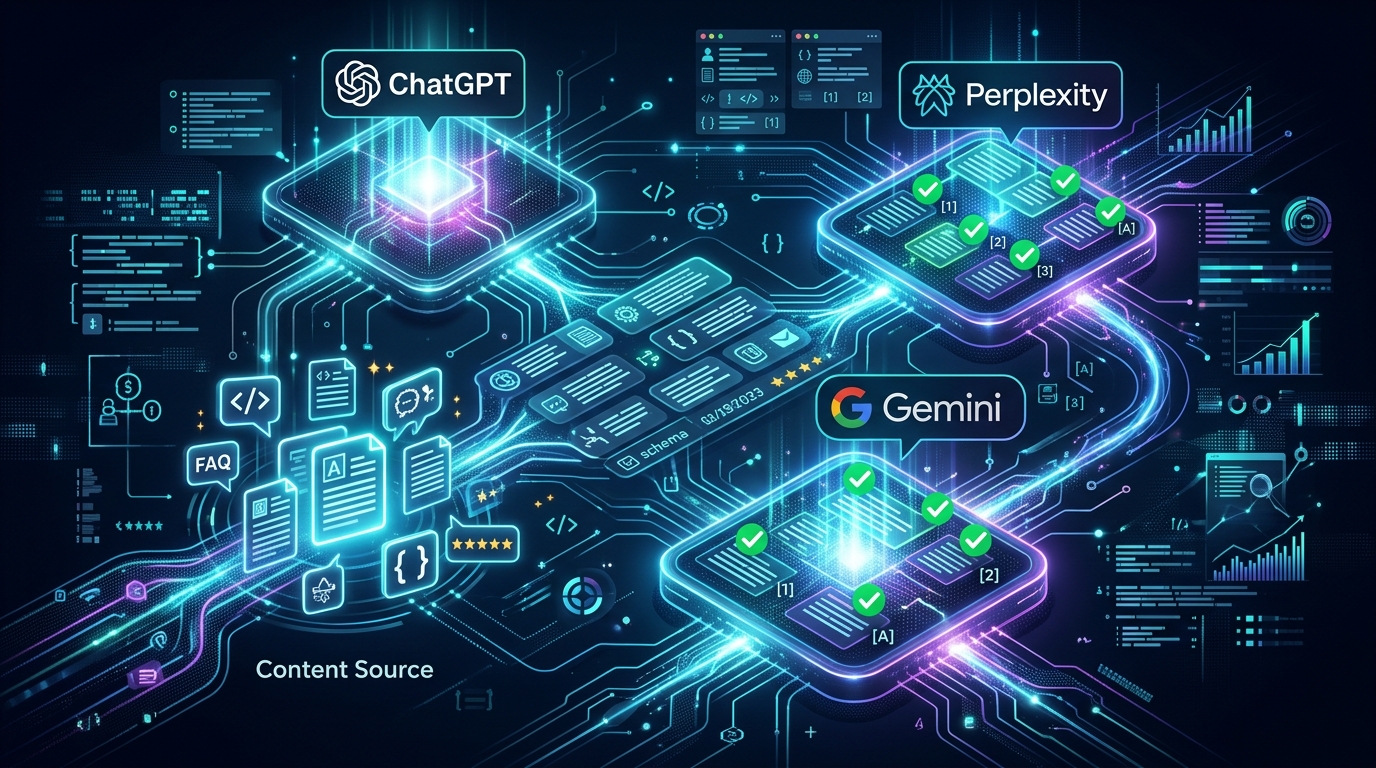
Answer Engine Optimization (AEO) in 2026: How to Get Cited by ChatGPT, Perplexity, and Gemini
Mastering Answer Engine Optimization in 2026 is critical for brands to secure citations in ChatGPT, Perplexity, and Gemini as zero-click searches dominate.

The Evolution of Search: From Keyword Blue Links to Generative Answers
Search isn't a directory of links anymore. By 2026, the primary interface for information retrieval has transitioned from traditional search engine results pages to generative answer engines. Users expect synthesized, direct responses rather than a list of websites to curate manually. This shift requires a move from traditional Search Engine Optimization to Answer Engine Optimization. AEO focuses on positioning your brand assets to be retrieved, analyzed, and cited by Large Language Models that power platforms like ChatGPT, Perplexity, and Gemini. The growth of zero-click searches means that visibility within the generated response is the new high-value real estate. If your content isn't ingested and synthesized by these models, your brand becomes invisible to a significant portion of modern information seekers.
The mechanics of how these models work require a shift in how we approach content architecture. Traditional SEO relied on ranking signals that prioritized page authority and keyword density. Modern AEO demands topical authority, technical accessibility, and concise, information-dense content blocks. Answer engines operate on Retrieval-Augmented Generation. They retrieve relevant information from their indexed sources and augment the model's knowledge to generate a response. Your goal is to be the most accurate, reliable, and accessible source for that retrieval process. Understanding the technical requirements of these engines isn't optional for digital marketers; it's a prerequisite for survival in the current environment. We're optimizing for machines that read for intent and facts, not just machines that crawl for keywords. This requires a deeper understanding of technical SEO foundations, which you can further refine by reviewing advanced prompt engineering techniques to better align your content generation with how LLMs process information.
To succeed, you must move beyond the "10 blue links" mentality. In 2026, data suggests that over 60% of mobile search queries result in zero clicks, meaning the user consumes the AI-generated answer and moves on. If your brand isn't the source cited in that snippet, you lose the opportunity for discovery. Tactics involve structuring your content so that the "why," "how," and "what" are immediately accessible. For instance, instead of writing an introduction that beats around the bush, start with a direct answer block. If a user asks "What is the best CRM for small businesses in 2026?", your article should immediately define the top three contenders in the opening paragraph. This directness makes the content "RAG-ready," allowing the model to pull your text with higher confidence than content that requires the model to summarize pages of fluff before reaching a conclusion.
Benchmarking the Engines: Perplexity, ChatGPT, and Gemini Mechanics
Each major engine employs a distinct strategy for content ingestion and citation. Perplexity prioritizes extreme recency. Its index updates at an accelerated pace, often refreshing core data every 2 to 3 days. For brands, this means that outdated content isn't just ignored; it's actively deprioritized. To gain citations in Perplexity, you must provide the most current information available on a topic. If your content is six months old, you're functionally obsolete in Perplexity’s retrieval pool. Strategies for Perplexity require consistent content updates and a focus on real-time data or events. ChatGPT, heavily reliant on the Bing search index, prioritizes broad information retrieval and contextual synthesis. It excels at answering complex, multifaceted queries by aggregating data from multiple reliable sources. ChatGPT favors content that's well-structured and provides comprehensive, definitive answers.
Gemini takes a blended approach, heavily weighting citation and topical trust. It frequently evaluates the source's authority relative to the query's subject matter. Gemini is more likely to cite sources that demonstrate deep, niche-specific expertise. It effectively combines real-time search capabilities with its underlying model training. To succeed across these platforms, you must build a cross-platform content strategy. You need a mix of real-time, frequently updated content for Perplexity, authoritative, comprehensive content for Gemini, and structured, high-relevance content for ChatGPT. This requires a shift in operations toward continuous content maintenance rather than one-time publishing. You aren't writing for a static page; you're writing for an active, evolving knowledge base. For further reading on the foundational aspects of this shift, explore CXL's AEO guide to ground your technical understanding.
Tactically, benchmarking your content involves running "Engine Audits." For Perplexity, test your core keywords every Monday morning. If your competitor is appearing in the citations because they posted a "2026 update" while you're still hosting a 2025 guide, update yours immediately. For ChatGPT, focus on the "synthesizer" aspect. Build content that connects dots across your niche. If you're in fintech, don't just write about "interest rates." Write about the *impact of interest rates on SMB liquidity*, linking to your own case studies. Gemini rewards "topical clusters", if your site covers a specific topic comprehensively (the "pillar-cluster" model), Gemini's internal weighting for your site as an authoritative source increases. You aren't just ranking for a word; you're building a knowledge repository that the model learns to trust as a source of truth for its answers.
Technical Foundations: Schema, E-E-A-T, and Answer-First Architecture
The technical backbone of AEO is structured data. LLMs heavily utilize schema markup to understand the context, purpose, and hierarchy of your content. Implementing FAQPage, Article, and Speakable schema is essential. These markups provide the machine-readable signals necessary to identify a clear answer, the context of that answer, and the legitimacy of the source. FAQPage schema is particularly effective for aligning with direct answer requirements. If a query is phrased as a question, having a corresponding FAQ entry formatted with schema creates a direct path for the engine to ingest and display your content as the solution. Speakable schema prepares your content for voice-activated search, which is increasingly integrated into these answer engines.
E-E-A-T (Experience, Expertise, Authoritativeness, and Trustworthiness) is the qualitative counterpart to your technical schema. Answer engines are designed to avoid hallucinations and prioritize high-trust sources. Your content must demonstrate deep, demonstrable expertise. Avoid surface-level content. Use original data, expert insights, and primary research. When an engine evaluates your content, it checks for consistent factual accuracy and authoritative claims. Answer-first architecture is the final piece of this technical puzzle. Every piece of content should lead with the answer. Your lead paragraph, ideally between 40 and 60 words, should contain the definitive response to the user's likely intent. Do not bury the lede. Do not force the engine to parse through fluff to find the fact. By prioritizing the answer, you increase the likelihood that the model will extract and display your text directly in its generated response. Reference the Search Engine Journal on GEO for deep technical implementation strategies that align with these principles.
To implement this concretely: first, map out your highest-intent queries and ensure every one of them has an FAQ block at the bottom of the page, explicitly marked with FAQPage schema. Second, audit your author meta data. In 2026, engines look for clear author credentials. Ensure your bios aren't just "The Marketing Team," but link to professional profiles that show the author's background in the subject matter. Third, practice "Answer-First" editing. Review your draft: if the first 50 words don't answer the primary query, rewrite the lead. For example, if the article is "How to fix a leaky faucet," the first sentence should be: "To fix a leaky faucet, first shut off the water supply under the sink, then disassemble the handle with a wrench to replace the O-ring or washer." This is data-dense, actionable, and perfect for extraction.
| Feature | SEO Strategy | AEO Strategy |
|---|---|---|
| Core Metric | Traffic / Clicks | Citations / Visibility in Response |
| Content Structure | Long-form / Keyword Rich | Answer-First / Structured Data |
| Indexing Focus | Link Building / Authority | Topical Trust / Technical Accessibility |
| Update Frequency | Periodic Updates | Continuous / Real-Time |
| User Intent | Click-Through | Direct Answer / Synthesis |
Tactical Execution: From Headings to Original Data
Execution requires changing how you write and format your articles. Headings aren't just for visual breakups; they're semantic anchors for answer engines. Use H2 headings that are phrased exactly as the questions your audience is searching. If the user asks "How do I optimize for Perplexity?", your H2 should be "How to Optimize Content for Perplexity". This alignment makes the engine's extraction process effortless. Once the question is set, follow it with a concise, factual paragraph that directly addresses the question. Avoid long, winding sentences. Keep paragraphs tight, focused, and limited to one or two main ideas. The easier it is for a model to chunk your content, the more likely it will use that chunk in an answer.
Original data is a competitive advantage that machines cannot replicate. If you rely on aggregated industry knowledge, you're replaceable. If you publish primary research, case studies, or original data sets, you become a necessary source. Engines prioritize content that provides verifiable facts and unique evidence. When you publish findings, cite your methodology clearly. This boosts your trustworthiness score, which is a major signal for models like Gemini. Structured FAQs at the end of every post provide additional opportunities to capture long-tail questions. Ensure these FAQs are also marked up with schema. Finally, maintain a strict editorial standard. Eliminate filler words and fluff. If a sentence doesn't provide a fact, a definition, or evidence, delete it. Precision is the language of machine intelligence.
A practical tactic for H2 usage: use "Question-Based Subheadings." Instead of an H2 labeled "Market Research Findings," use "What does the 2026 market data suggest about consumer spending?" This directly mirrors the user's query intent. Additionally, original data can be as simple as a 5-question survey of your own customers. Aggregate that into a chart and include a short, bulleted "Key Insights" section immediately below it. Machines love lists and tables because they're inherently structured. When you include a table, ensure the table headers are descriptive and the data is clean, models are excellent at scraping tables to generate comparative answers. If your data is in a table, it's significantly more likely to be cited in an AI-generated answer than if that same data is buried in paragraphs of text.
Operationalizing AEO: Continuous Improvement and Monitoring
AEO is a continuous process, not a one-time project. It requires an operational shift toward monitoring and iterating. You must track your brand citations across these platforms. If you aren't appearing in answers for your core topics, audit your content. Check if your answer-first blocks are clear enough. Evaluate if your schema is implemented correctly. Monitor your E-E-A-T signals. Are you updating your content frequently enough to be relevant for Perplexity? Is your content comprehensive enough for Gemini? This monitoring cycle should be part of your weekly workflow. Use the internal prompt engineering techniques mentioned earlier to test how your content is processed by these models. You can feed your published content into these engines with specific prompts to see how they summarize your brand and what citations they pull. This testing provides direct, actionable feedback on how you're perceived by the machines.
Adaptability is the hallmark of a successful AEO strategy. As engines update their algorithms and indexing strategies, your approach must evolve. Do not cling to old SEO habits that prioritized keyword stuffing or backlink volume over information utility. Focus on being the best source of truth for your niche. Build a content repository that's structured for machine ingestion and optimized for human readability. This requires collaboration between your marketing and technical teams. Marketers focus on the intent, the expertise, and the data, while technical teams ensure the structure, the schema, and the accessibility. Together, this integrated approach positions your brand as a foundational source for the next generation of search.
To operationalize, create a "Citation Dashboard." Use a simple spreadsheet to track your brand's presence in the summaries of key target queries. If you notice Perplexity has stopped citing you for a topic, check the age of your content; it might be time for a refresh. If Gemini is consistently citing a competitor, read their content, is their data better? Is their answer more direct? Use this "competitive intelligence" to iterate. Treat your website content like software: it's never "finished." Version control your core articles, updating the data, adding new industry trends, and re-optimizing the H2s monthly. This agile approach to content is the only way to maintain visibility in a RAG-dominated search landscape.
Key Takeaways
- Prioritize answer-first architecture by placing definitive 40-60 word summaries at the start of your content.
- Leverage structured data schema like FAQPage and Speakable to provide machines with clear context.
- Maintain continuous content updates to ensure relevance and recency, which are critical for engines like Perplexity.
- Establish deep topical trust through original data and verifiable research to satisfy E-E-A-T requirements.
- Utilize semantic H2 headings that directly mirror the questions and intent of your target audience.
Conclusion
AEO is the new SEO. Contact Optijara's team to build your AI-search visibility strategy. Start here.
Frequently Asked Questions
What is Answer Engine Optimization (AEO)?
AEO is the practice of structuring content so AI systems like ChatGPT, Perplexity, and Gemini cite it directly in their generated answers. It focuses on answer-first content, clear structure, schema markup, and E-E-A-T signals.
How is AEO different from traditional SEO?
SEO targets search engine ranking positions. AEO targets inclusion in AI-generated answers. SEO focuses on keywords and backlinks; AEO focuses on extractability, authority signals, and direct answers to natural language queries.
Which AI engine is most important to optimize for?
Optimize for all three: ChatGPT (uses Bing index, prioritize Bing visibility), Perplexity (favors recency, update content every few days), Gemini (built on Google, blend citation signals with topical relevance and trust).
What schema markup is most important for AEO?
FAQPage, Article, Speakable, and HowTo are the most impactful schema types for AEO. FAQPage directly maps to AI FAQ extraction. Speakable marks content suitable for AI audio responses. HowTo provides structured instructional content.
How long does it take to see AEO results?
Results vary by platform. Perplexity can index and cite new content within days if the domain has authority. Google AI Overviews typically take weeks. ChatGPT's web browsing citations depend on Bing crawl frequency, usually 1-4 weeks for new pages.
Sources
- https://cxl.com/blog/answer-engine-optimization-aeo-the-comprehensive-guide/
- https://www.searchenginejournal.com/geo-strategies-ai-visibility-geoptie-spa/568644/
- https://blog.hubspot.com/marketing/answer-engine-optimization-trends
- https://www.marketingtechnews.net/news/answer-engine-optimization-aeo-a-comprehensive-guide-for-2026/
- https://www.darwinapps.com/blog/how-to-rank-in-perplexity-ai-complete-guide-2026/

Written by
OptijaraHamza Diaz is the founder of Optijara, where he builds practical AI agents, automation systems, and Copilot workflows for service businesses. He writes about AI operations, agent strategy, and real-world implementation for teams that want usable systems instead of hype.