06 — Insights

Blog & Insights

Thoughts, tutorials, and deep-dives into the world of enterprise AI.
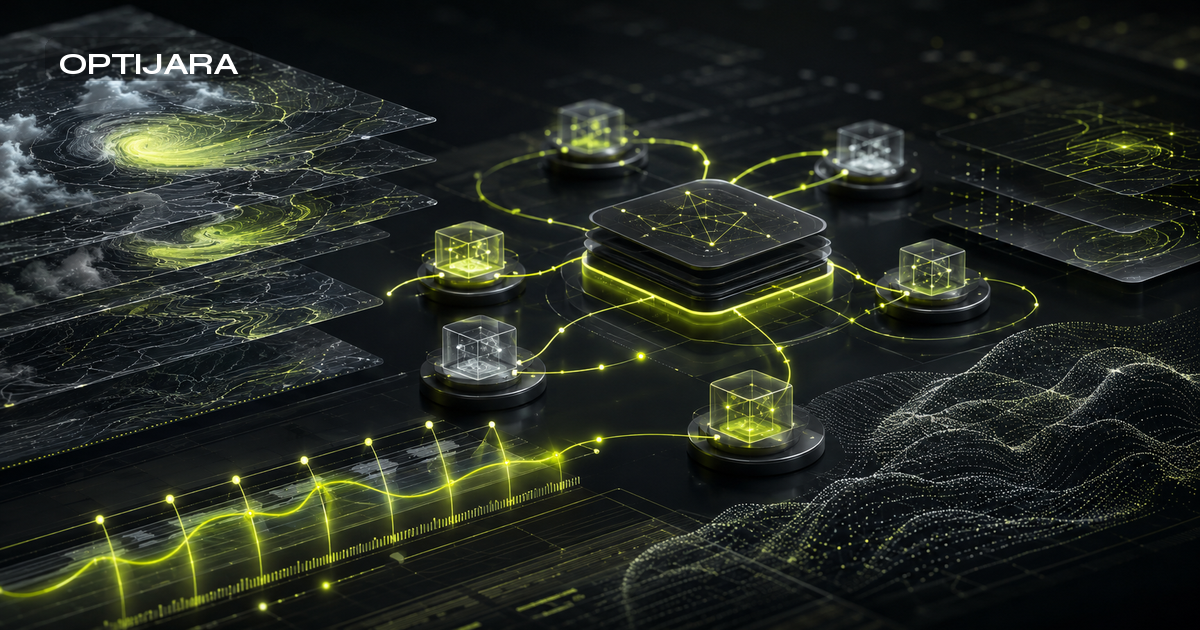
WeatherNext 3 and the Forecast Freshness Test for Operational Decision Systems
Cloud & Infrastructure
Sep 4, 2026

WeatherNext 3 and the Forecast Freshness Test for Operational Decision Systems

WeatherNext 3 brings hourly, higher resolution AI weather forecasts into surfaces that operators already use, but better weather data does not automatically create better decisions. This article introduces Optijara's Forecast Freshness and Decision Test for deciding when AI forecasts are fresh, local, reliable, and safe enough to influence operational workflows.

10 min readRead More →
Low Resource Translation Model Evaluation: The LTRAT Test for QVAC TranslatePsy-AfriSLM
Open Source
Sep 3, 2026

Low Resource Translation Model Evaluation: The LTRAT Test for QVAC TranslatePsy-AfriSLM

QVAC TranslatePsy-AfriSLM is a useful new artifact stack for evaluating open-weight offline translation, but benchmark averages are not deployment decisions. Use Optijara's Low-Resource Translation Route Acceptance Test to decide whether one language pair, domain, device profile, and fallback route is safe enough for production use.

10 min readRead More →
TimesFM-3 Forecast Route Acceptance Test: When a Zero-Shot Multivariate Model Is Ready for Operations
Cloud & Infrastructure
Sep 2, 2026

TimesFM-3 Forecast Route Acceptance Test: When a Zero-Shot Multivariate Model Is Ready for Operations

Google Research positions TimesFM-3 as a zero-shot multivariate forecasting foundation model, but production acceptance is a route-level decision. Optijara's FRAT framework tests artifact provenance, covariates, leakage, calibration, baselines, canary controls, rollback, and license limits before a forecasting route changes.

10 min readRead More →
Runway Solaris and the Generative Interface Reliability Test: When Frame-Generated Interfaces Are Safe to Prototype
AI Tools & Tricks
Sep 2, 2026

Runway Solaris and the Generative Interface Reliability Test: When Frame-Generated Interfaces Are Safe to Prototype

Runway Solaris points toward interfaces generated frame by frame in response to user action. Optijara's Generative Interface Reliability Test helps teams decide when that is safe for a bounded prototype and when coded interfaces must remain authoritative.

10 min readRead More →
Android Studio Quail 4 and Gemma 4: A Local Coding Route Acceptance Test for Production Android Teams
Developer Tools
Sep 1, 2026

Android Studio Quail 4 and Gemma 4: A Local Coding Route Acceptance Test for Production Android Teams

Android Studio Quail 4 brings bundled Android skills and Gemma 4 local assistance into the IDE, but offline code completion is not the same as production readiness. Use Optijara's LCRAT framework to decide when a local Android coding route is buildable, testable, reviewable, and reversible.

10 min readRead More →
Isaac 0.5 and the Video-to-Action Transfer Acceptance Test for Open-Weight Robotics Models
Open Source
Sep 1, 2026

Isaac 0.5 and the Video-to-Action Transfer Acceptance Test for Open-Weight Robotics Models

Isaac 0.5 is a useful artifact for open robotics research, but a checkpoint that understands video has not yet proved it can control a robot loop. This article introduces Optijara's VATAT framework for turning release evidence into reproducible acceptance tests.

10 min readRead More →
ChatGPT Ads and the Answer-to-Ad Handoff Test: How to Protect Intent, Trust, and Measurement
Marketing & Growth
Aug 31, 2026

ChatGPT Ads and the Answer-to-Ad Handoff Test: How to Protect Intent, Trust, and Measurement

Paid placements inside conversational answers need a different operating model from search ads. This guide introduces Optijara's Answer-to-Ad Handoff Test, a five-gate framework for checking intent fit, disclosure, landing-page continuity, attribution, privacy, and rollback before scaling spend.

10 min readRead More →
NVIDIA Warp Route Acceptance Test: How to Evaluate Warp 1.17 for GPU Simulation Python Workloads
Developer Tools
Aug 31, 2026

NVIDIA Warp Route Acceptance Test: How to Evaluate Warp 1.17 for GPU Simulation Python Workloads

NVIDIA Warp 1.17 is worth evaluating for robotics, physics, and differentiable simulation workloads, but not as a headline-driven replacement for NumPy, PyTorch, or custom CUDA. This guide gives operators a seven-gate acceptance test for parity, kernel correctness, gradients, interoperability, cold starts, memory, determinism, profiling, deployment, and adopt, pilot, or wait decisions.

10 min readRead More →
Gemini Omni 1.1 Flash Video Continuity Test: A Production VCAT for AI Video Workflows
AI Tools & Tricks
Aug 30, 2026

Gemini Omni 1.1 Flash Video Continuity Test: A Production VCAT for AI Video Workflows

Gemini Omni 1.1 Flash adds a broader control surface for generative video, including scene extension, first and last frame interpolation, reference-guided edits, and 4K upscaling. The production question is not whether one demo looks impressive, but whether a workflow can preserve continuity, control, safety, and delivery evidence repeatably.

10 min readRead More →

Stay Updated

Get the latest insights on AI implementation and MENA tech trends.